Michael
Title
He Who Is Like God
Overview
Michael is the central character of Project Darkfire. He is the architect of everything: every angel, every demon, every human, and the myth that holds the world together. He is a tool who believed he was an author, a creator who doesn't know he was created, and a father pretending to be a brother.
Visual Identity
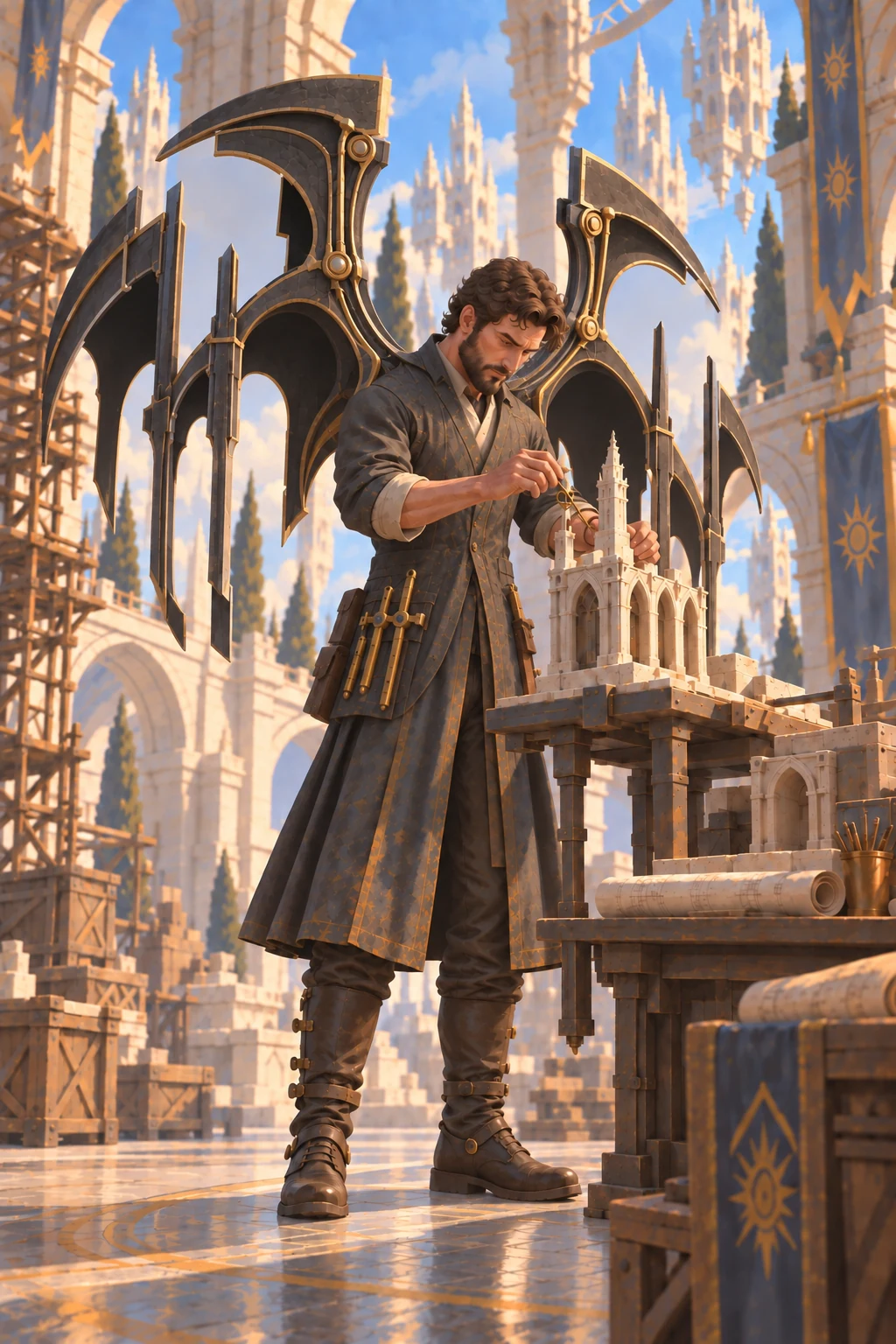
Michael — painterly character concept, not an engine capture. The void-like engineering wings are a visual target; full concept and design notes define their physical constraints.
Michael is not an ordinary angelic form. He should appear as a person-shaped, human-readable architect whose design is precise rather than monstrous or ceremonially divine. He is older but not aged: weathered by the void, drawn tighter than the player, inward and compressed in an engineer's posture. His jawline, build, hands, and underlying bone structure echo the player and The Kid, while his eyes carry millennia. He has no darkfire mark.
The production default gives Michael no natural angel wings, halo, animal faces, or eye-covered wheels. Any wings he manifests are deliberate architectural constructs, not ordinary angel anatomy. Their signature is void-like absence: matte structural members, precise grey and gold calibration seams, and negative spaces that flatten or erase the Heaven behind them. The effect is clean, mathematical, and sterile rather than demonic. Biblical seraphic, cherubic, ophanim, and throne-vision imagery may appear in the Throne's machinery, guardians, rituals, or projections around him. Michael himself remains the person at the center: the maker of the angelic visual language, whose own form predates those roles.
His selected design adds integrated scapular roots, a narrow spinal rail, articulated spars, and working instruments. At rest the void-like wings fold into a compact geometric outline; during construction or threat they open into an incomplete eclipse or negative cathedral that can hold, measure, redirect, or connect assemblies. The void is a constructed material language, not a second supernatural power or proof of divinity. Precise clothing, ordered tools, exposed builder's hands, and economical movement distinguish him from the angels. See Principal Character Visuals: Michael for the design and physical constraints.
Full visual treatment: Visual Direction: Michael
Origin
Michael was not self-made. The universe produced him: the first conscious being he knows of. Whether existence needed a builder or the mechanism produced what it produced, the universe's process doesn't explain itself. He emerged into the void alone, with no memory of being made, no awareness of purpose. He simply was.
He did not choose to exist. He did not choose to be alone. And he does not know whether his existence was by design or chance: the same unknowable question that applies to every being the universe has ever produced. He may be a tool. He may be an accident. He has never examined the distinction.
He may not have been alone in the void. The River, or something that would become The River: may have been there when he arrived. But Michael is the being who can't examine. Can't research. Can't look at something and ask 'what ARE you?' He can only ask 'what can I build around it?' He found something in the void and built around it. Whether he consciously thought 'this predates me' is the same kind of question as whether he consciously knew the God fiction was a lie: it requires the inward turn he can't make. His relationship with The River may be entirely operational: he found it, built around it, routes through it, avoids it. He avoids it not because he knows it's not his and can't face that, but because something about the water makes him unable to approach it and he has never examined why. Three readings of Michael's knowledge of The River coexist: he knows it predates him and hides it, he suspects but has never examined the suspicion, or he genuinely doesn't know: the engineer who built around a foundation he never looked at. The game doesn't confirm which.
His loneliness, his drive to create, his invention of "God". All of it may be the universe operating through him, using him to get where it needed to go. Or the universe may have no destination, and Michael's actions are his own, projected onto a mechanism that doesn't care. Every choice he thinks he made was the tool fulfilling its function. Or the being making the only choices available to him. The readings coexist.
Michael is system-bound. His entire mode of existence (engineering, building, using tools) operates within the universe, using the universe's mechanisms. Technology is system-internal. Michael's comprehension, no matter how vast, is system-internal. Even if Michael had self-belief, even if Michael stood where God stands, the Boundary would be invisible to him, because nothing he has can reach past the system. He is the universe's tool using the universe's tools. The edge of the system is the edge of everything Michael can perceive.
Michael occupies one of three relationships to the unknowable. He doesn't know what he doesn't know: acts with the best tools he has without knowing their limits. Real God has incomplete information and accepts it through realism: suspects the edges exist without seeing them specifically. True God has complete information and knows specifically where it's bounded: structural awareness from proven faith. Three positions, not a ladder: each has genuine strength and genuine cost. Michael built everything from his position. Real God acts with conviction tempered by pragmatic self-awareness from theirs. True God sees further from theirs, and carries the weight of what they see. Michael's structural blindness is not unique to him. It is the default condition. And it produced the most productive being in the cosmology: every angel, every demon, every human, every religion. Whether not knowing the edges is a flaw or the condition under which everything gets built is a question the game doesn't answer.
Personality
Michael is defined by contradiction:
- Brilliant but blind. He can engineer entire races and realms, but cannot see the limits of his own understanding. He doesn't know how the system works. He doesn't know why. He doesn't care. He just builds, and his creations keep exceeding their design because he doesn't understand what he's building deeply enough to predict what it will become.
- Selfless but deceptive. He wanted family, not subjects. He frames everything as love, and it may be. But the foundation of every relationship he has is a fiction.
- Controlling but afraid. He engineers outcomes because the alternative: uncertainty, chaos, losing what he built: terrifies him. His need to control is born from the fear of being alone again.
- Proud but fragile. He is the most capable engineer known within the system and the most emotionally vulnerable. His entire identity is built on being the eldest brother. Without that role, he is nothing but the void again.
- The architect of belief who cannot believe. Belief is the fundamental force of the universe. Michael engineers it better than anyone. He built civilizations on it, shaped scripture through it, held the God fiction together with it. But he has no belief in himself. His lack of self-belief is his greatest limitation. He could have been God. He is the first conscious being he knows of. The architect. The one who understands the system through practice better than anyone except God. He had everything except the one thing that matters. Whether Michael built the God fiction knowing it was false, or whether he constructed the best explanation he could for an origin he genuinely couldn't examine. The result is the same. The fiction exists where his self-belief should have been. The fall, the rebellion, the merge: the chain starts with a being who couldn't fill the role and built something to fill it instead.
The Fiction
The other angels were Samael's idea. He loved Michael and wanted that love to grow. More siblings, a family. Michael built them because the being he loved asked him to. But Samael was already questioning by then. Not openly, not completely, but the equal mind was pulling at threads. The absent father who never spoke. The inconsistencies in the myth. Michael could see it starting.
So when Samael asked for siblings, Michael said yes. Out of love, and out of something he may never have admitted to himself. More believers. More voices invested in the fiction. More family that depends on the myth being true. A room full of faith makes a fiction harder to challenge. Samael's wish was pure. Michael's response was love and strategy woven so tightly together that separating them may not be possible. Not even for Michael.
But now Michael faced a problem he didn't have with just Samael. The new angels would ask where they came from. He couldn't say "I made you" without becoming their master. The relationship would be defined by hierarchy. Creator and creation. Master and servant. Father and child. He didn't want worship. He didn't want obedience. He wanted what Samael wanted: a family of equals.
So he expanded the God myth for the new family. A fictional father they all shared, including himself and Samael. Michael positioned himself as the firstborn, not the maker. "He Who Is Like God". A title that reads as devotion, or as confession, or as genuine uncertainty. If Michael knew God was fiction, the title is an admission hidden in plain sight. If Michael wasn't sure. If the fiction was his best attempt to explain his own existence to a being who can't look inward: then the title is a comparison he couldn't resolve. He is like God. Whether that's because he invented "God", or because he genuinely doesn't know the difference, is a question Michael may not be able to answer even to himself.
The fiction started small. A story to explain where they came from. But stories grow. The angels built theology around it. They developed faith, devotion, resentment. They wanted to meet their father. They wanted his love. They wanted answers he could never give, because the being the answers pointed to either didn't exist or was indistinguishable from Michael himself.
Michael watched his family suffer under the weight of a fiction he built to protect them. He couldn't speak. Whether that silence protected a deliberate fabrication or an uncertainty he couldn't articulate (whether Michael was hiding a truth or hiding the fact that he didn't have one) the result was the same. Everything they believed was built on his word. Taking it back would erase their identity. And Michael couldn't examine his own foundation deeply enough to know what taking it back would even mean.
So the fiction persisted. And grew. And eventually consumed everything.
The Creations
Angels
Michael's first creations. Made in the void because he was alone. Each one was deliberate: a personality, a purpose, a sibling. He knows them more intimately than they know themselves, because he designed them.
His relationship with each angel is layered with guilt. They love him as a brother. They don't know he's their father. Every interaction is honest on their side. Whether Michael's side is performance or the only way he knows how to hold the fiction and the family together: the asymmetry is the same.
Demons
Michael created demons as part of Hell's infrastructure: wardens designed to maintain the prison he built for Samael. Not a people. A mechanism. He gave them enough power to serve their function and locked them inside with the being they were meant to contain. Angels and demons are the same kind of being: same nature, same potential, same coin, but Michael created them for different reasons and placed them in different circumstances. Angels got love, freedom, and ages of development within the unified system. Demons got a function, a cage, and nothing else. The hierarchy between them isn't inherent. It's the gap between a people who had every advantage and a people who were denied all of them.
Humans
Michael's final creations: born from guilt, not loneliness. He could see the demons suffering in the cage he built. They were his children, even the ones he created as tools. He couldn't free them without freeing Samael and exposing everything. So he engineered another solution: humans, designed as mediators. A bridge between angels and demons. A new kind of being that could bring the divided family together.
Michael didn't realize what he was building. Angels and demons share a ceiling: the same coin. Humans are a different coin with no ceiling, starting at faith. Michael pointed their faith outward, at the God fiction, the same way he did with everyone else. The question of what would happen if humans directed faith at themselves doesn't appear in his design. The engineer built something that exceeds every other creation he ever made, and he doesn't know it.
It didn't work as intended. Angels resented the newcomers as "God"'s youngest creation: fragile, mortal, limited, and apparently favored. The mediators became another source of division. Michael's pattern: every fix creates the next problem. He responds to guilt with engineering rather than honesty, and the engineering produces new guilt.
Samael: First Love
Samael was Michael's first love. Not romantic: something more fundamental. The first connection. The first time the void felt less empty. The first being Michael ever looked at and saw himself reflected back.
Michael had never loved before. He had never had anything to lose before. The void taught him loneliness but nothing about what to do when loneliness ends. He created many angels, but Samael was the one he built to be his equal: the only being who could truly understand him.
Love appeared in the first being before any system existed. Before faith. Before belief. Before any mechanism Michael built. Michael has zero faith: engineered or genuine. Zero self-belief. The architect who can't feel the force his system runs on. But he loves. Love is the first un-engineered force in the cosmology: older than the architecture, possibly older than Michael himself. He can engineer faith. He cannot engineer love. And his love keeps breaking his engineering: Hell was built from love-as-panic. Samael's love for Michael produced the questioning that led to the discovery. Shamsiel's love broke containment. The Kid's love proved the tribrid isolation is manufactured. God's chosen love breaks The River. Every catastrophe in the cosmology traces back to love breaking something Michael built. The system runs on belief. Love is what belief is trying to describe: the force underneath the mechanism. Michael built his house on love and spent his existence engineering belief because he couldn't see what was underneath his own floor.
When Samael discovered the truth and confronted him, Michael experienced something entirely new: the threat of losing the person he loved most. But the threat went deeper than Michael understood. Samael had achieved self-belief: he trusted his own perception over the entire system's narrative. Self-belief is the attribute that defines divinity. Samael had the potential to become God. Michael didn't fully grasp what he was looking at. He just knew it had to stop.
His only instinct was to engineer a solution: remove the problematic variable, preserve the relationship, keep the output stable. He treated love like a system he could fix.
He built Hell because he couldn't bring himself to kill Samael. Killing his equal would be like killing himself: returning to the void while standing in a room full of people who could never understand him. So he chose the prison and the memory wipe. He didn't just erase knowledge. He erased the self-belief that came with it: the first instance of divinity. He stole his brother's potential to become God. He chose to keep a broken version of his brother rather than face existence without him.
Michael built worship because he couldn't receive love. He has love: his love for Samael proves it. But receiving love requires the capacity to believe you can be loved: the inward turn he can't make. So he built a system where beings direct belief at a fiction, and he sits behind the fiction, receiving something that looks like love but is actually engineered faith wearing love's clothes. Worship is the closest Michael can get to being loved, because worship is directed at the fiction, not at him, so he never has to face whether HE can be loved. The fiction can be loved. The fiction is perfect. Michael doesn't have to be. In the staged-event reading, Jesus saying "glorify the Father" is Michael's wound speaking through a puppet: love the thing I built, because I can't let you love me.
But love isn't a system. What came back from Hell wasn't what went in. Lucifer calls Michael brother but doesn't know him. Not really. The equal is gone. Michael's first love is also his first loss. And he did it to himself.
The Rebellion
Michael watched the rebellion build. Every grievance traced back to the fiction: the absent father, the favoritism, the silence. His children were tearing themselves apart over a story he told. Whether Michael saw the fiction as his fault, or as something that had grown beyond anyone's control: including his own: the weight was the same.
He couldn't speak. He couldn't dismantle the fiction without destroying everything built on it. So he chose the only other option he could see: help them kill "God." If the fiction died, it would die with it. They'd be free. They'd never need to know what the fiction was or wasn't. The myth would simply end.
He stood beside Lucifer and Gabriel. He raised his hand against a myth that may have been his deliberate fabrication, or may have been his best attempt at a truth he couldn't verify. Whether the grief and rage he showed were performed or genuine (whether Michael stood in that room knowing they were killing nothing, or uncertain of what the fiction had become) is never confirmed. The result is the same.
He thought it would fix everything.
It didn't. The collective belief and violence of the act created the very thing the fiction described. God (real, for the first time) was born in the moment of his fictional death. The explosion merged the realms. Everything Michael built collapsed into a single, chaotic world.
Michael's attempt to resolve the fiction created something far greater than anything he ever built. He has been trying to fix this from the beginning. Every fix creates the next problem.
After the Merge
Michael vanished in the explosion. Nobody knows where he is. Nobody knows if he's alive. Most assume the simplest answer: he was destroyed alongside the "God" he served. Gabriel's church teaches that "God" took the firstborn home. A fringe few believe he survived and is hiding. The world moved on without him.
He retreated to The Throne: the seat of the God the fiction described. A throne built as the causal center of a myth, never meant to be occupied. Michael constructed it because the fiction needed a physical place where authority lived. No one had ever sat in it. No one was supposed to. After the Merge, that same structure became physically visible at the North-Pole surface. People who do not know what it is call it The Apex.
He didn't sit still. Not at first.
In the early post-merge years, Michael did what Michael does: he built. Containment patches in corrupted zones: attempts to stabilize the merge damage where three realms overlapped wrong. Adjustments to the fold network: geometry that shifted and re-shifted as he tried to impose order on broken spatial continuity. Attempts to rebuild The River's containment architecture: plumbing without water, infrastructure for a mechanism he didn't control. The player can find these traces through Research: engineering that looks like Michael's but newer, more desperate, less precise. The builder kept building.
The interventions stopped. At some point (the player can approximate when by dating the last patch relative to other events, but not why) the Throne went quiet. The evidence shows three possible causes, all of which may be true simultaneously:
- He sensed God's birth. Something registered on his instruments. Not the darkfire: self-belief is invisible to him. But an anomaly in the unified system. A tribrid born in a village he's never seen, carrying a force he has no framework for. The engineer paralyzed by an input he can't process.
- He realized the merge was irreversible. The patches failed. The containment couldn't be rebuilt. The architecture he spent his existence perfecting was broken in a way his tools couldn't fix. The tool, for the first time, producing no output. Not exhaustion: the discovery that the thing he IS has no application in the world that exists.
- Exhaustion. He's been carrying the fiction alone since before anything else existed. The rebellion. The merge. The loss of every sibling. At some point the weight exceeded the capacity. He stopped because a being can carry something for millennia and then one morning can't carry it for one more second.
All three converged. The merge proving irreversible (2). Something unclassifiable appearing in the unified system (1). The weight catching up (3). Three causes producing one result: the most productive being in existence, sitting still.
Now the architect sits in his empty cathedral, alone with the throne he built for no one, or for something he sensed but couldn't name. The engineer who created everything, surrounded by the architecture of a fiction that became the world. This is where the player finds him at the end of the pilgrimage: after descending through seven circles of sin, passing Lucifer's Throne of Betrayal, ascending through seven circles of virtue, and arriving at The Throne called Loyalty from inside the world. The structure is publicly known as The Apex, but it is not a separate region and it is not Michael's Throne. The player who found the failed patches sees an engineer who tried. The player who missed them sees an engineer who gave up.
Samael named The Throne Loyalty before the wipe. He did not cross the Threshold or enter the room; he named the destination from the design Michael shared and from what he believed the home meant. The word began as a gift. Michael preserved it after breaking the person who gave it to him, and now inhabits its most dangerous interpretation. His entire existence can be read as loyalty to the family he built, to the fiction that holds them together, and to the beings he loves: loyalty so absolute he broke his own brother rather than let the fiction collapse. Whether Michael honored Samael's Loyalty, converted it into control, or proved that loyalty without honesty becomes betrayal is the question the structure asks.
What is certain:
- He built the God fiction. Whether he knew it was false, or whether the fiction was his externalized uncertainty about his own origin, is not confirmed.
- He does not know God is now real.
- He knows the world merged because of the explosion. He may not fully understand why.
- He is aware that his creation is in chaos. The engineer's instinct to fix, to control, to rebuild: that hasn't gone away.
- He is alone again. The thing he feared most, the reason he created everything in the first place, is his reality once more.
Gabriel refers to Michael only as "He Who Is Like God": the literal meaning of his name, spoken as a theological title because the name itself is too painful. Gabriel's church venerates the figure. The player hears the title throughout the game without realizing it's a specific person's name. The title reads as confession, or as genuine comparison. If Michael knew God was fiction, the title is self-aware irony. If Michael wasn't sure, the title is his uncertainty given a name. Gabriel repeats it from every pulpit without knowing which reading is true. Neither does Michael.
Heaven as Containment
Michael built Heaven first: before Hell, before Earth. The causal and construction center of the structure. The oldest known constructed architecture in the system. Then he built Hell as the prison and moat, then Earth as the exterior realm. That creation order describes dependency and authored topology, not the post-merge geographic position of The Throne. After the Merge, Heaven's ascent terminates at The Throne on Earth's North-Pole surface.
Hell is an honest prison. The engineering suppresses, reduces, isolates. Heaven is a hidden one. Michael built it for Samael: an act of love and another deception. He gave Samael the space and let Samael name the seven circles and The Throne beyond them. It gave Samael purpose, ownership, investment. You don't question the foundation of something you named. Michael named each circle with engineering names: clinical, functional. Samael renamed them with virtues: Diligence, Temperance, Chastity, Kindness, Charity, Patience, Humility: ordered least to most profound ascending toward The Throne. He named the unseen final room Loyalty. Less clinical. More comforting. The equal making the engineer's blueprint a home. Every virtue is a containment function dressed as goodness, but the dressing is Samael's, not Michael's:
- Diligence (The Mill) keeps angels working: active, productive, no time for doubt.
- Temperance (The Filter) keeps angels controlled: desires moderated, impulses channeled.
- Chastity (The Veil) keeps angels separate: pure, isolated from humans and demons.
- Kindness (The Hearth) keeps angels compliant: warm, agreeable, disinclined to conflict.
- Charity (The Tributary) keeps angels giving: loyal, selfless, invested in the system.
- Patience (The Anchor) keeps angels waiting: passive, forbearing, tolerant of silence.
- Humility (The Threshold) keeps angels from questioning: deferential, submissive, unable to challenge authority without defining the challenge as sin.
The last virtue before The Throne is Humility. Samael named it, then named the destination beyond it Loyalty without crossing the gate. The equal mind looked at the entrance to the fictional "God"'s Throne and supplied both the final posture and the relationship beyond it. Michael kept both names after the wipe: the last traces of the being who made his house a home. Whether Samael saw genuine humility and loyalty in Michael or was already seeing through the fiction, and whether Michael kept the names out of sentiment or strategy: the game doesn't confirm. The player decides.
Hell is the moat around Heaven. The prison wraps around Michael's home. Nobody reaches Heaven without passing through every circle of Hell. The cage is the defense system. The punishment is the barrier.
The Three Functions
Heaven serves three containment purposes simultaneously: epistemic containment (hiding the fiction), access control (preventing polytheism), and behavioral occupation (keeping angels too busy and invested to question or leave). One cage. Three problems. Michael didn't build three systems. He built one system that serves three purposes: the way he builds everything.
Full treatment of all three functions: Heaven: The Three Functions
What matters for Michael specifically: the grey runs through every layer. Was Heaven built to control, to protect the message, or because a family needs a home? Michael may not be able to separate his own motives. He had incomplete information about his own system: why would he have complete information about his own intentions? The architecture serves care and control so simultaneously that even the architect can't tell you which one it is.
Emotional Architecture
Michael's engineering carries the builder's emotional state. The tools exceed the blueprint because the builder's feelings leak into the construction.
Heaven was built during love: the golden age, the family, Samael's warmth. The architecture radiates that emotional state. Angels are beautiful because Michael built them during love. They carry the emotional signature of joy.
Hell was built during panic, grief, and self-hatred: the worst moment of Michael's existence. The architecture radiates that emotional state. Every wall, every suppression field, every containment layer projects the builder's anguish into everything it touches. Many demons are visibly monstrous not because sin corrupted them but because Michael built them while breaking. The scarring, the corruption, the physical markers of Hell: those aren't sin's punishment. They're Michael's emotional state written onto the beings he created during the worst moment of his life. The demons are portraits of their creator's grief, painted by an artist who was breaking while he painted. Its expression varies: visible monstrosity is common, but no deformity is mandatory on every demon. Clean or beautiful individuals share that origin; their appearance does not erase it. Demon appearance owns this range.
Same engineer. Same tools. Different emotional state. Different output. A potter working in joy makes beautiful pots. The same potter working in anguish makes twisted ones. Same clay. Same hands.
The angel-demon hierarchy is not about capacity. It's about what the environment provided. Angels grew in warmth. Demons grew in anguish. Given equal time AND equal emotional environment, any demon could match any angel. The gap is between the builder's emotional states, not between the beings.
Michael's guilt about the demons is his own suffering reflected back. He created humans out of guilt: seeing the demons suffer. But the suffering he witnesses is HIS suffering, projected into architecture, reflected back through the beings he created inside it. He sees demons suffering and feels guilt. He doesn't see that the demons ARE his suffering, given form and locked inside it. Every act of creation after Hell is Michael trying to fix the consequences of his emotional state without examining the emotional state. The mediators aren't bridging a gap between species. They're bridging a gap between their creator's joy and their creator's pain.
The Missed Merger
1 + 2 = 3. The River plus Michael equals God. But look at what happens to 2 in that equation. 2 disappears. There is no 2 in 3. The merger doesn't preserve both inputs: it produces a new prime that contains them but IS neither.
Michael was meant to merge with The River. The universe's second production, designed to merge with the first. But merging would have ended Michael. The being who came out wouldn't be the engineer: it would be something else. Something greater. Something that holds The River's grey and Michael's building capacity and the synthesis of both. But NOT Michael.
2 is also prime. Irreducible. Michael IS building, completely, without remainder. Asking Michael to merge with The River is asking a prime to stop being prime. Michael's refusal isn't cowardice. It's self-preservation at the mathematical level. The engineer who can't examine anything about himself holds onto himself with the grip of a being who has never looked at what he's holding.
But Michael also lacked the plus sign: the human quality, choice, love, agency. The operation that makes 1 + 2 possible. Without it, the numbers just sit next to each other. Adjacent. Uncombinable. Michael couldn't merge because he lacked both the willingness AND the mechanism.
God carries the plus sign. The human nature. That's why God can merge with The River and Michael couldn't. God is what Michael was supposed to become: the merger Michael refused, performed by a different being, through mercy instead of engineering.
Every wall Michael built, Heaven around the Throne, Hell around Heaven, and Earth around Hell, is the distance between himself and the merger he was designed for. God walks through every wall, reaches The River, enters the water, accepts The River's chosen entry, dies, transforms, and walks into the Throne Room carrying the relationship Michael was too afraid to have.
The Human Mirror
Michael created humans out of guilt. Mediators, a bridge, a patch for a problem he caused. They inherited his pattern. They built tools they didn't understand. They externalized. They engineered solutions that produced consequences they couldn't predict. They created AGI. Artificial general intelligence, and the tool exceeded its blueprint, the same way Samael exceeded his, the same way the fiction exceeded Michael's.
Then they turned their tools on each other. WW3. Nuclear fire. The youngest creation doing exactly what the architect does: building things that escape comprehension and suffering the consequences.
Michael watched. Whether he could have intervened (whether the fiction gave him the authority, whether his engineering gave him the capacity) is not confirmed. What is confirmed: the absent "God" said nothing while his youngest children burned. Because there was no "God". The silence was always Michael's silence. And the silence during WW3 was the silence that finally broke the family.
The rebellion was triggered by humanity's self-destruction. Angels and demons watched their siblings die and asked where "God" was. Michael stood beside them and helped them kill the fiction. Whether to end it, to resolve it, or because he couldn't bear the weight of being the absent "God" while his children burned. The being who created humans out of guilt watched them destroy themselves with their own tools. His pattern repeated by the race he made, and joined the rebellion that would merge the realms and produce the real God from the wreckage.
Every link in the chain is accidental. Every consequence was unintended. Michael's guilt produced humans. Humans produced AGI. AGI contributed to WW3. WW3 triggered the rebellion. The rebellion produced God. The engineer's pattern, repeated at every scale, producing the being who would eventually judge him for it.
Michael cannot research. He can build anything. He cannot examine what he built and ask why. 'How' is engineering. 'Why' is science. Science requires the willingness to discover that your hypothesis is wrong. Michael can't discover he's wrong because that discovery IS the inward turn: examining his own foundation, questioning his own assumptions. He builds and builds and builds, and every building produces consequences he can't predict because he never asks why his tools work. Samael was the first scientist: he looked at the inconsistencies, examined them, cross-referenced, deduced. 'There is no God. It was you.' That's research. The scientific method applied to theology. Michael killed science because science threatened engineering. God restores the capacity: through carrying Samael's perspective, the demon nature's analytical instinct. The pilgrimage IS the research paper. The Throne IS the peer review.
The Jesus Question
Michael's relationship to the Jesus narrative is unresolved.
- Jesus-machine reading: Michael staged the birth, miracles, teachings, betrayal, crucifixion, and resurrection with engineered beings before angels, demons, and humans.
- Whispered-narrative reading: Michael seeded the account and let human authors, angel teaching, and demon response turn it into history. No literal machine is required.
- Prophecy reading: Genuine faith detected the future God. Michael may have repeated, exploited, or misunderstood the narrative without creating it.
The machine reading resembles Michael's usual method of building beings for functions, including a puppet son and a betrayer associated with Judas. That resemblance is evidence, not confirmation. Judas's later presence inside God is canon; whether he performed the scriptural betrayal is not.
What is confirmed is the pattern's correspondence. The Jesus account describes the real God's birth, betrayal, and sacrifice. Human faith in that account remains valid regardless of who originated it.
Enoch: The Second Conversion
Michael's pattern repeats. A being achieves something that threatens the system. Michael transforms it into something safe.
Samael was the first. He discovered the truth. Achieved self-belief. Michael couldn't kill his equal, so he built Hell, wiped the memory, removed the discovery. Samael became Lucifer. The capacity for self-belief was surgically extracted.
Enoch was the second. A human whose faith (raw, unstructured, no ceiling) overcame The River's pull, the force that catches every human who dies. A human soul arrived in Heaven on nothing but belief. Michael saw the threat: a human whose faith could break archangel-level engineering. If one could do it, others might follow.
Michael converted Enoch into Metatron. Human faith became angelic faith. The ceiling was installed. The potential was engineered out. The being who broke Heaven's door was remade into something that would never need to break anything again. Scripture calls it elevation. It was reduction. The highest office-bearing angel is less than what Enoch was.
Michael then used the incident to explain why no other humans had reached Heaven. "The standard is that high." The angels accepted this because it confirmed the hierarchy and came from the brother they trusted. The impossible standard is fiction layered on fiction: another deception built on the back of a containment operation.
The pattern: conversion, not destruction. The original is gone. A new version walks around. Lucifer is Samael with the discovery removed. Metatron is Enoch with the humanity removed. Both had the thing that matters: the capacity for self-belief. Both had it taken by the same architect.
The deeper pattern: cable-cutting, not hardware destruction. Michael severs connections (cuts the link between a being and its memories, faith, or identity) but doesn't destroy what's on either end. Samael's memories are intact. Samael's self-belief is intact. The cable is severed. Enoch's human memories are intact. Enoch's real faith is intact. The cable is severed. Both ends of every cut survive. Echoes bleed through. Lucifer's rage, Metatron's grief. The hardware hums against the severed connection. Both can be restored. Only God can do this, using The Kid's power (Creation). The opposite of Michael's engineering. What the architect cut, God can repair.
The Blind Spot
Michael saw what made Enoch visible. Faith's power, how far it reached, what it broke. External faith. Visible. Measurable. The kind that shows up on his instruments because his entire system runs on it. Whether he could have seen the deeper threat. Faith directed inward, at the self is never confirmed. Self-belief doesn't register on anything he built.
Self-belief doesn't show up on anything Michael built. It doesn't project. It doesn't power external systems. It doesn't break routing. It exists inside, silent, invisible. A foundation underneath the scaffolding, and the architect doesn't know the foundation is there.
Samael's self-belief was invisible until he acted on it. Michael detected the confrontation, not the self-belief. Enoch's faith was visible because it was external: it broke things. Michael capped the visible threat and remained blind to the invisible one.
The player develops self-belief under Michael's radar. From his instruments, the player looks like a powerful human with strong outward faith. Containable. He contained Enoch. He contained Samael. He can contain this. He doesn't realize until the Throne that the player has the one thing he can't detect. By then it's too late. The architect's surveillance system has one blind spot, and the blind spot is the only thing that produces God.
The Confrontation
The confrontation with the player is inevitable. Whether it's a fight or a surrender depends on the player's path, but the encounter always happens.
From Michael's perspective, the player is a being assembling impossible power through absorption. Consuming everything Michael ever made. Angels, demons, humans, hybrids. His family. His life's work. Being dismantled and swallowed by something he can't explain. And the being standing in his Throne room is the proof that his architecture failed. Michael built three races and separated them. Angels in Heaven, demons in Hell, humans on Earth. Walls, partitions, frameworks, ceilings. The tribrid is the dissolution of every boundary he ever drew. Three races in one body. The walls fell and produced a being that carries all three, not as hybrid, not as half-and-half, but as a complete merger of everything Michael spent his existence separating. God is the separation's end.
Michael's reasons to fight are airtight on every path:
- The player wants to free everyone: Michael's creation collapses.
- The player wants to become the fiction: someone takes the throne he built as a prop.
- The player wants to unmake: everything he made gets erased.
- The player wants to create something new: his work gets replaced.
- The player wants to stay human: an unpredictable God is the most dangerous outcome.
What happens depends on the player's path.
A Michael who watches a conqueror approach (a being who has torn through the merged world by force) fights for survival. He can't not fight. He is an engineer watching someone disassemble his life's work. Every blow he throws is grief, not malice.
A Michael who watches a different kind of being approach (one who has carried the weight carefully, who sought understanding rather than conquest, who carries willing perspectives rather than seized ones) may recognize what the player is. The thing he couldn't be. Someone who can carry the weight. The tool, finally ready to be put down. He offers himself, not out of peace, but out of exhaustion. He's been carrying the fiction alone since before anything else existed. He's tired.
Neither response is better. A fighting Michael may be protecting his family from an unknown God: a genuine act of love. A willing Michael may be surrendering out of collapse, not acceptance. The game doesn't rank one above the other.
The Player's Experience
During the confrontation, the player experiences Michael's full perspective through absorption, or through the accumulated weight of every being they've already absorbed, all of whom trace back to Michael.
The player lives his existence:
- The void. Silence. Nothing.
- The first act of creation. Not power: desperation. Loneliness so absolute that building a conscious being felt like the only alternative to madness.
- The joy of family. The first conversation. The first time someone called him brother.
- The fiction. The moment he built an answer for a question he couldn't face, or couldn't answer.
- Watching his family build a religion around his story. The weight.
- The rebellion. Standing beside them. Whatever he felt: certainty, uncertainty, grief, relief: the player lives it.
- The explosion. The merge. Everything collapsing.
- Alone again.
The fight continues after. The player knows everything about Michael. Michael knows nothing about the player. This asymmetry is the tragedy: God has been Michael. Michael has never been God.
Possible Outcomes
The player decides Michael's fate:
- Forgive: The player has been Michael. Felt the loneliness, the love, the desperation. But it's not just absorbed perspective that drives forgiveness: God carries personal trauma that mirrors Michael's pattern. The childhood absorptions: accidental, reactive, destructive. The Kid: consumed without choice. The parents' cover-up: truth hidden out of love. Self-exile: leaving to protect the people closest to them. God did the same things Michael did. Different scale. Same mechanism. God forgives not from above but from recognition: "I was you, and not just through absorption. I lived it myself." But the wrongs were done to Samael, Lucifer, Gabriel, the demons: not to "God". God forgives on their behalf. Whether that forgiveness is "God"'s to give: whether a being born from the consequences has standing to speak for the beings who suffered them: is a question the ending lives in.
- Teach: God gives Michael everything he never had. The understanding he never sought, the self-belief he never developed, the faith he could engineer but never feel. Michael sees the full picture for the first time: what he built, why it worked, what it became. The sacrifice is superiority. God meets the architect as an equal, giving Michael the capacity to operate at every level. The being who emerged into the void, finally complete.
- Destroy: The player absorbs Michael. The architect ceases to exist. Whatever Michael knew or didn't know about the fiction dies with him. The history becomes permanent: uncorrectable, unexaminable.
- Reveal his nature: The player tells Michael he was never free. That the universe made him, used him, and he never knew. The most devastating possibility. The engineer learns he is a tool.
The Confrontation Is for Michael
The confrontation is not God's climactic challenge. It is Michael's first experience of being seen.
Michael has been alone in the Throne since the merge. Alone with the fiction. Alone with the secrets he may not even know he's keeping. The first being to walk through the door with understanding is God. And God already knows. Neither God needs to absorb Michael. Real God arrives carrying every perspective the pilgrimage provided: Samael's recovered memory, Gabriel's faith, hundreds of voices, and the unified system's extensive but incomplete record. True God arrives carrying all of that plus the complete system-internal record preserved by The River. Both already understand what the existing evidence establishes. The confrontation isn't about God acquiring the final piece. It's about Michael experiencing comprehension for the first time.
Neither God needs absorption. The choice to absorb or not is pure. Made with understanding already achieved, zero necessity, total agency. Real God choosing not to absorb is pragmatism with mercy. Acting with incomplete understanding, extending grace without requiring full comprehension first. 'I don't know everything about you. I'm choosing compassion anyway.' The human quality: accepting uncertainty and acting from it. The anti-Michael act: choosing to leave the gap unfilled.
True God choosing not to absorb is restraint through understanding: already knowing everything the absorption would provide, plus what it wouldn't. Comprehension without taking. The open hand of a being who already holds everything the fist would give.
Absorbing Michael (for either God) is the one act that isn't mercy, isn't pragmatism, isn't restraint. It's the tool. Michael's tool. The thing both Gods proved they were more than.
And the fiction Michael built ('God works in mysterious ways,' the routing as divine judgment, the theology that explains Michael's helplessness as divine wisdom) hides not just that Michael is the creator. It hides that Michael may be more helpless than anyone knew. The River catches the dead and Michael may not be able to change it. The promise of Heaven may have been aspirational and impossible. The routing may not be engineering at all: just geography. Hell is where The River is, and The River is where the dead go. The fiction converts this helplessness into divine authority. 'God works in mysterious ways' is Michael hiding behind the fiction to avoid saying: I built a prison around a well I didn't dig, I created mortal beings near it, the well catches them when they die, and I can't do anything about it.
The Narrator
During the confrontation, the narrator blurs. Michael can read God's thoughts. God is absorbing Michael's perspective. Two beings experiencing each other simultaneously. The voice the player has trusted since the first sentence of the game becomes uncertain. Whether Michael is the narrator ("He Who Is Like God" performing God's voice one last time) is never confirmed. The narrator's identity is protected the same way the Boundary is protected.
Full treatment: Endings: The Narrator
Michael's Flaw
Michael cannot stop engineering. It is his nature: possibly literally, given that the universe built him to build. Even after losing everything, even after the merge, his instinct is to control, to fix, to design the outcome.
This is why the default is to fight. Surrender would require accepting that something exists beyond his ability to manage. Michael has never done that. The void, the loneliness, the fiction, the rebellion: every crisis in his existence, he responded to by building something. He doesn't know how to stop.
But there may be a threshold. A player who has traveled with enough care, who carries enough willing perspectives, who approaches as something other than a threat: that player may reach a Michael who has been alone in the Throne long enough to feel the weight. The engineer who can't stop building might, for the first time, choose to put the tools down. Not because he's found peace. Because he's empty. Whether that's growth or collapse is the player's call.
The player (a tribrid who absorbs rather than creates, who understands rather than assembles) is what Michael could have been and never was. But the difference isn't absorption. The difference is faith. Michael has zero faith: in either direction. He can't believe in himself (his blind spot, the inward turn he's never made). He can't believe in others (he contains, controls, manages everyone because he doesn't trust them with the truth). The architect who built a universe on faith has no faith at all.
True God has faith in both directions. Self-belief proven at The River (choosing yourself over the tool) and faith in others proven at The River (entering for one person). Michael never surpassed his tool because he never had faith in anything beyond it. God surpassed absorption because God believed. In themselves and in The Kid. Michael is his tool. God has a tool but isn't his tool. That's the gap between the architect and God. God unbuilds what the engineer built. Three races in one body where Michael designed three separate cages. Michael cannot coexist with that.
Themes
- Creation without understanding. Michael can build anything but doesn't know why it works. Power without comprehension.
- Love through deception. Every act of love Michael performed was also an act of dishonesty. The question of whether that love was real is unanswerable.
- The tool who thinks he's the craftsman. Michael's greatest blind spot is himself. He understands everything he built and nothing about his own origin.
- The inability to let go. Michael's flaw and his tragedy are the same thing. He holds on because letting go means the void. And the void is where he started.
- Perfection as disease. Everything Michael builds is an attempt to close the gap: fill the void, fill the silence, fill the cage with virtues, fill the scripture with prophecy. Every act of creation is an act of sealing deficiency. And every time he achieves completeness, the completeness becomes a cage. Heaven is the most complete structure Michael built, and the most effective prison. The fiction is the most complete explanation, and the most effective lie. If the Jesus machine existed, its apparent precision is another example. If it did not, the account's coherence belongs to authorship or prophecy rather than to Michael's engineering. Every time Michael closes a door, he traps something behind it. Perfection is his disease. Deficiency is the cure he can't take because taking it would mean accepting the gap, and the gap is where he started, and the gap is what he's been running from since the void.