Lucifer
True Name
Samael
Title
The Morning Star. The Light Bearer. The Rebel.
Once: Michael's Equal. The Second-Born.
Overview
Lucifer is the tragic center of the rebellion. A being driven by a wound he cannot see, leading a war whose true cause he cannot remember. He was born Samael, created by Michael to be his equal, his true brother, the second-born. Though he was never told any of this. He was the only being ever built to stand beside Michael as a peer, and he never knew it.
He was too perfect. He saw half the truth. Michael broke him for it.
Everything Lucifer has done (Hell, the demons, the rebellion, the murder of "God") traces back to a hole in his memory and a confrontation he can't fully recall. He is not a revolutionary. He is someone in pain who built a cause around the ache.
Visual Identity
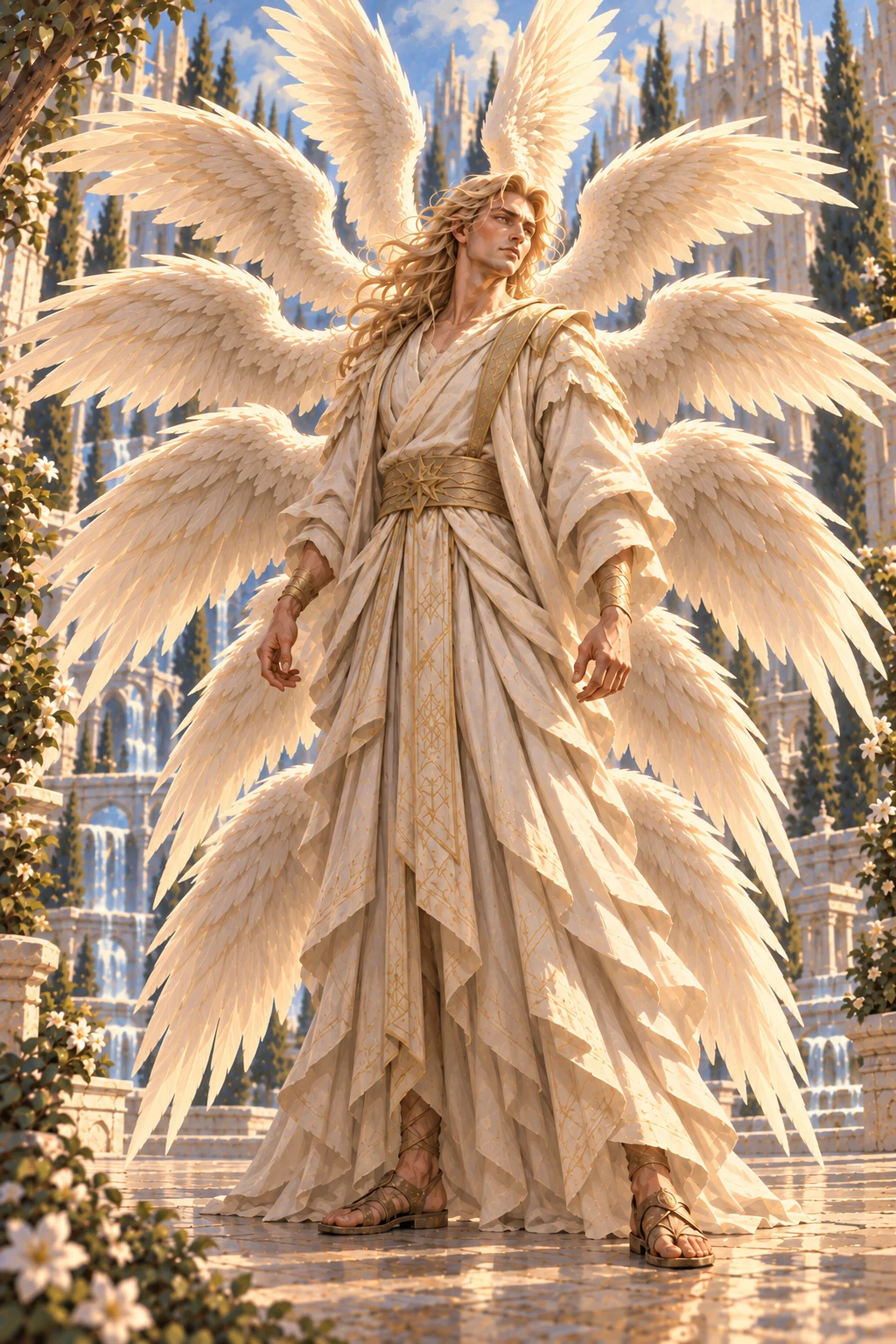
Samael — clean identity portrait, painterly visual concept, not an engine capture.
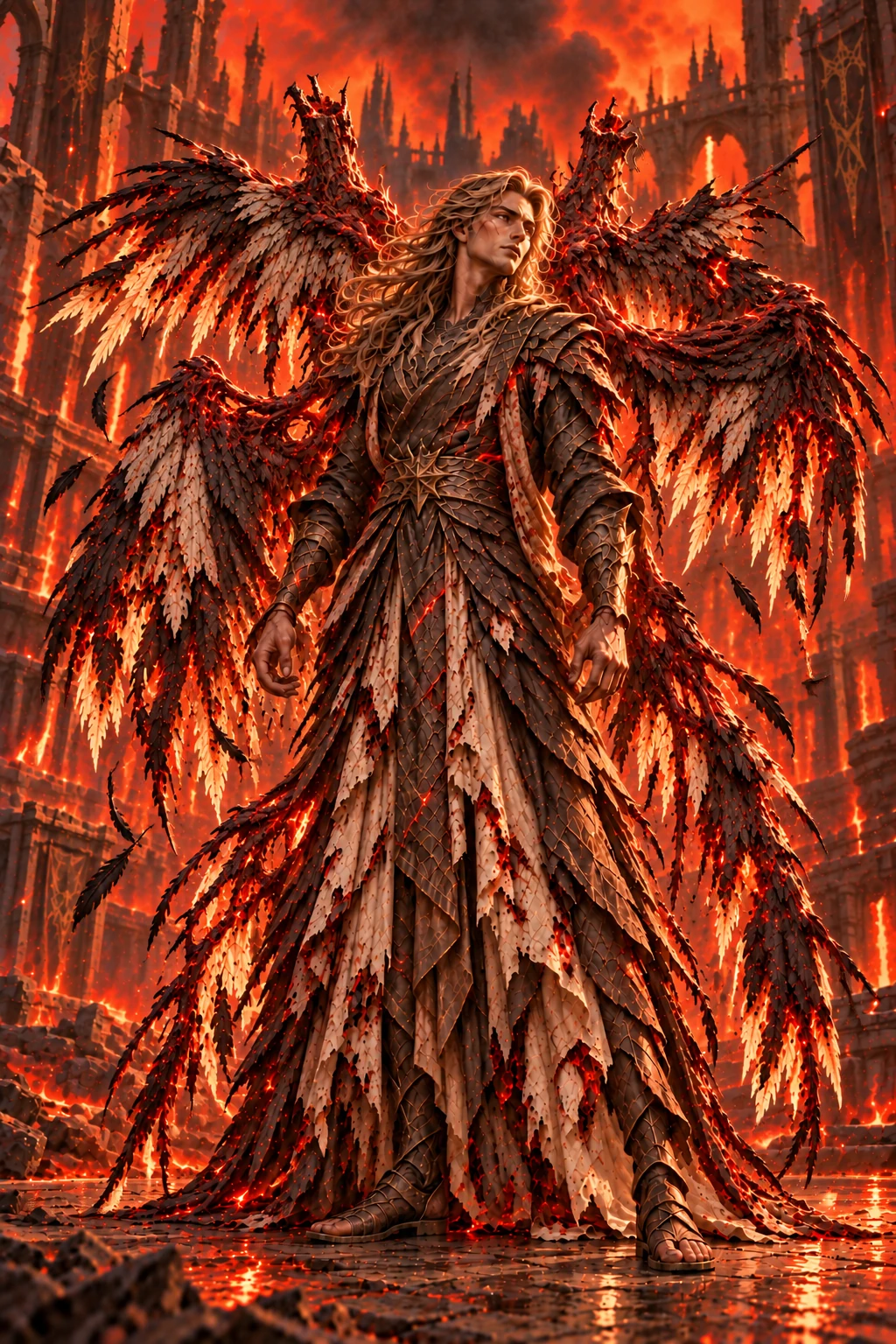
Lucifer — clean identity portrait, painterly visual concept, not an engine capture.
Samael is a radiant, twelve-winged primordial equal: six distinct physical pairs surround an otherwise beautiful humanoid figure. His upper pairs rise behind the head, middle pairs extend outward, and lower pairs frame the body and descend around the legs. He is severe, intelligent, and almost painful to look at, with no outwardly demonic feature. Lucifer retains that same twelve-wing body plan beneath Hell's damage: pairs have fused, collapsed, burned together, or hang from scarred roots; pale feathers survive beneath soot, cinder, infernal repairs, and ember fissures. His soot-darkened blond hair remains recognizably Samael's in the portrait: long, loose, and center-parted. The charcoal scale-textured shirt and armour, muted trim, and pale underlayer remain the same outfit; Hell's warmer light is environmental, not a costume change. During the absorption transformation, the twelve-winged form becomes whole again as the corruption falls away. Full direction and the selected concepts are in Principal Character Visuals.
Origin
Michael created Samael with a singular purpose: to have an equal. Every other angel was made with care, with love, but none of them were built to match Michael's mind. Samael was. He was the answer to Michael's original loneliness. Not just another sibling in the family, but the one who could truly understand him. Samael was never told this. To himself, he was just another angel. Perhaps sharper than some, more restless than others, but not fundamentally different. Another layer of Michael's deception.
Samael was Michael's first love. Not romantic: something more fundamental. The first connection he recognized. The first time the void felt less empty. The first being Michael ever looked at and saw himself reflected back. Michael had never loved before, never had anything to lose before. The void taught him loneliness but nothing about what to do when loneliness ends.
Samael was brilliant, perceptive, and relentless. He thought like Michael. He questioned like Michael. He saw patterns where others saw certainty. Michael gave him these qualities deliberately, because a brother who couldn't challenge him wasn't a brother at all. But he never told Samael why he was different. He never told him what he was capable of. He gave him the power of an equal and the awareness of a subordinate.
This was Michael's most consequential act of creation.
The Discovery
Samael was questioning before the other angels existed.
When it was just the two of them (Michael and Samael, alone in the void with a story about an absent father) the self-belief was already the engine. An equal mind develops faith in its own perception. Where every other being Michael will create directs faith outward (at God, at the system) Samael's faith turned inward. He trusted what he saw over what he was told. That's why he pulled at threads. The father who never spoke, never appeared, never answered. Not a full discovery yet. Just self-belief doing what self-belief does: refusing to accept a story that doesn't match what you see.
When Samael asked for siblings, the request was love. When Michael built them, the response was love too, and something else. More believers reinforcing the myth. More faith making the fiction harder for one questioning mind to dismantle. Samael never knew his wish for family may have been answered, in part, to bury his own doubts under the weight of collective belief.
But the self-belief didn't stop. The other angels accepted the silence because their faith pointed outward. At God, at Michael, at the system. Samael's faith pointed inward. He wasn't built for external faith. He was built to trust himself. The God myth had inconsistencies that deepened as the theology grew more elaborate. Foundational questions went unanswered. And Samael. Who had been pulling at these threads longer than anyone: eventually pulled hard enough.
He confronted Michael directly. Brother to brother. Samael didn't know he was Michael's equal: he only knew the fiction was a fiction.
"There is no "God". It was you."
What happened next is the defining tragedy of the story.
The Betrayal
Michael panicked. Not out of cruelty. Out of heartbreak.
If the truth came out, the family would collapse. Everything Michael built (the relationships, the structure, the mythology that held them together) would disintegrate. The angels would see him not as a brother but as a deceiver, a manipulator, a false god who hid behind a fiction.
But he couldn't kill Samael. Killing his equal would be like killing himself. Samael was the only being in existence who thought like Michael, saw like Michael, understood like Michael. Destroying him would mean returning to the void while standing in a room full of people. Every other angel was his creation, but none were his equal. Without Samael, Michael would be truly alone again: surrounded by family that could never understand him.
So Michael did what he did. He kept his brother but erased the part of him that knew. Not cruelty. Not strategy. Desperation. A being who had never loved before, facing the loss of the only connection he'd ever had, and reaching for the only tool he knew: engineering. He couldn't destroy the only being that made him feel less alone, even if that being had become the biggest threat to everything he'd built.
Michael engineered Hell, not as a realm of punishment, not as part of some grand design. Hell was built in a moment of desperation. A cage constructed in panic by someone who couldn't bear to lose his brother and couldn't bear to be known by him.
He placed Samael inside. And he wiped the memory.
Not all of it. Just the truth. Just the discovery, the confrontation, the knowledge that God was a fiction and Michael was the creator. He cut it out surgically, the engineer operating on his own brother's mind. Cable-cutting, not hardware erasure: Michael severed the connection between Samael and his memories, between Samael and his self-belief. He didn't destroy what was on either end. The memories are intact. The self-belief is intact. The cable is severed. Both ends survive, disconnected, humming against the cut.
This means Samael can be restored. The cable can be repaired. Reconnected. Only God can do this, using The Kid's power (Creation). Absorption takes in the severed connection. Creation joins the two ends back together. Restored Samael remembers everything. The discovery, the confrontation, the wipe. What Michael's equal does with complete memory and a real God in the room is one of the greyest questions the game can produce.
Hell wasn't punishment. It was a father telling himself he's protecting his child while breaking something irreplaceable.
What Remains
Samael went into Hell as Michael's equal. Lucifer came out as something less.
The memory wipe left a hole. Not a gap in knowledge: a wound in his soul. Lucifer can feel its absence every moment. Something fundamental was taken from him and he doesn't know what.
Lucifer's first memory is Samael's last: Michael.
Samael's final conscious moment: looking at the brother who is about to erase him. The face of the being he loved, the being who built him as an equal, the being who is choosing the wipe over the truth. Then nothing.
Lucifer's first conscious moment: the same face. No context. No memory of the confrontation, the discovery, the love. Just Michael's face and something enormous attached to it. A feeling with no framework. A weight with no source. Then rage.
The same instant. Two beings in one body. One ending, one beginning. The last image before the wipe and the first image after it are identical. The wipe removed the knowledge. It couldn't remove the snapshot. A face isn't information. It's a scar.
From Lucifer's perspective, Michael's face is the foundation of his entire existence: burned in at the moment of his creation. He hates Michael and doesn't know why. Not ideology. Not theology. The first thing he ever saw as Lucifer was the face of the being who erased Samael. The rage has a target it doesn't understand because the target was there before the understanding was removed.
That's why he defaced Hell. The walls are Michael's. The architecture is Michael's. Everything in Hell is the closest Lucifer can get to the face he can't reach. Tearing at the walls is tearing at Michael by proxy. Centuries of rage directed at the only available surface of the brother who is simultaneously the last thing Samael loved and the first thing Lucifer hated. Same face. Same feeling. Opposite meaning.
That's enough for a lifetime of rage. More than enough.
The Direction
Michael's surgery was imprecise. He removed the capacity (self-belief, faith in one's own perception) but he left the direction. Samael's faith pointed inward. It was the defining feature of his mind: where every other angel directed faith outward at "God", at the system, at Michael, Samael trusted what he saw over what he was told. The inward direction is what led him to the discovery. Michael cut out the faith. He couldn't cut out the orientation. The steering wheel is locked in position. The engine is gone.
What does inward-directed energy look like without faith? Rage. Pointed at himself as much as at Michael. The defacement of Hell isn't just outward aggression: it's inward destruction that can't stay inside, spilling onto the nearest available surface. Lucifer tears at Michael's walls because the walls are there. But the rage started inside him and found its way out the same way it does for everyone. People do this. When they're angry at themselves, they lash out. They break things. They push away the people closest to them. They damage what's around them because they can't sit with what's inside them. Lucifer defacing an entire realm is the same mechanism as a person punching a wall. The wall isn't the problem. The wall is just there.
The inward direction explains everything about Lucifer that the wound alone doesn't cover. Why he stays in Hell. The cage matches the inward rage; he punishes himself the way the prison punishes him, and some part of him agrees with the containment. Why the defacement marks thin near the Throne. The inward direction intensifies as he approaches the source of the wound, and the closer he gets, the less he can externalize. Why victory didn't fill the hole: killing "God" was an outward act, and the wound is inward. The rebellion pointed outward. The damage points inward. No amount of outward conquest touches an inward wound.
Self-belief became self-destruction. Same vector. Opposite payload. Samael looked inward and found truth. Lucifer looks inward and finds a hole. The direction works. There's nothing there to find.
The Name
Samael was a name Michael gave with love. The name of an equal. A true brother.
Lucifer is what emerged from Hell. The name change isn't a choice: it's damage. He stopped being Samael in that cell. He adopted a new name because the old one belonged to someone whole, and he is not whole.
But the name he took (or the name that found him) means something different to everyone who says it. Three readings of the same word, none aware of the others:
Angels hear a criminal. "Lucifer" is the fallen name. The after-name. They use it the way you'd use a convict's alias. The real person is gone, replaced by what the crime made him. The meaning of the word. Light Bearer: doesn't register. It's just what you call the one who fell. Some angels won't even say it. Gabriel avoids it entirely.
Demons hear a savior. Lucifer. The Light Bearer. He carried light into Hell. He brought them from darkness to the surface, from the cage to the sky. The name describes what he did: he bore light into a place that had none. Every demon who says "Lucifer" is saying "the one who brought us into the light." The name is a title of honor, spoken with something approaching reverence.
The truth is deeper than either. Samael carried the light of truth. He saw through the fiction. He is the one being who held the revelation that could illuminate everything. The name isn't a mark of the fallen and it isn't just about liberation from Hell. It's the most accurate thing anyone has ever called him: honoring his discovery in a language nobody is listening to.
All three readings are genuine. All three are incomplete. And they coexist. The name is a condemnation, a title of honor, and a memorial to erased truth, all at the same time. The angels who use it to condemn are unknowingly commemorating his greatest act. The demons who use it to honor are closer than they know to the real meaning. And nobody. Not angels, not demons, not Lucifer himself: hears all three at once.
The memory was wiped but the name survived. Samael's discovery was erased. His name for that discovery wasn't.
The inversion with the player. Lucifer = Light Bearer. Two words. A bearer and a thing being borne. Separated. The light is the product. The bearer is the delivery mechanism. Michael's engineering: take the light, put it in a container, ship it. The name is the separation made linguistic.
The player carries darkfire. Two things in one word. Fire that is dark. Darkness that is fire. Not separated. Fused. Not a product being carried. A process burning. You can't split the dark from the fire because they're the same force. You can't steal it because it's not an object. You can't cut it out because it has no seam: the prime that no factoring algorithm reaches.
Lucifer's name is Michael's greatest act of separation, memorialized in a word. The darkfire is the being that refuses to be separated, burning in the same cosmology. The Morning Star. A point of light visible at dawn, separate from the darkness around it. Darkfire. Fire fused with darkness, inseparable, indivisible, prime.
He may not consciously understand this. But on some level, he knows Samael is gone and Lucifer is what's left.
Personality
Lucifer is defined by the hole:
- Charismatic but hollow. He leads with conviction and fire. Others follow him because he burns brighter than anyone. But the heat comes from a wound, not a furnace. His conviction is pain wearing a mask.
- Brilliant but incomplete. He still has Samael's mind: sharp, perceptive, relentless. But it's a mind with a blind spot carved into it. He can see everything except the one thing that matters.
- Angry but lost. His rage against "God" is bottomless and genuine. But it's misdirected. He thinks he hates God. He actually hates what was done to him: he just can't see it.
- Proud but fragile. He presents himself as the liberator, the one who dared to act. Beneath that is a being who was violated by the person he trusted most and can't even articulate what happened.
The Demons
The demons were Lucifer's jailors. Michael created them as part of Hell's architecture: wardens designed to keep Samael contained. They were locked inside the prison with the prisoner, given enough power to serve their function and no understanding of what they were or why they existed.
Angels and demons are the same kind of being: same nature, same potential, different sides of the same coin. The power gap between them is development, not design. Angels had Heaven and ages of growth within the unified system. Demons had a cage. Given equal time and equal access, any demon could match any angel. The hierarchy was circumstance, not nature.
Lucifer (broken, raging, but still an angel and secretly Michael's equal) outclassed every one of his guards. And he recognized their situation. They were caged too. Their job was to contain him, but their existence was containment. The prisoner and his wardens shared the same walls.
He taught them. How to reach beyond Hell. How to whisper to human minds. How to access parts of the unified system that Michael never intended them to touch. He was jumpstarting the development that the cage had denied them: giving them access to abilities they always had the potential for but were never given the chance to reach. Before Lucifer, demons were tools. After Lucifer, they were people. The being they were designed to contain became the being who gave them agency.
Lucifer freed them because he understood imprisonment. His alliance with them isn't strategic. It's kinship. Fellow prisoners: even if they started on different sides of the door.
The Rebellion
Every angel resented the absent father. Lucifer was the one who acted.
He is literally blinded by his rage. The memory wipe didn't just remove knowledge. It removed his ability to see clearly. His anger has no target he can identify, so it floods everything. It became the lens through which he sees the entire world. God, angels, hierarchy, injustice. All of it filtered through a fury whose real source was surgically removed.
This is the tragedy of most wars made literal. Soldiers fight for causes they've lost sight of. Grievances get passed down, distorted, mythologized, until the people fighting have no connection to what started it. They just know they're angry and someone told them why. Lucifer is that truth given form: a being fighting for something he cannot remember, who built a cause around a wound he can't see.
His anger runs deeper than theology. Every other angel rebelled over neglect, jealousy, or philosophical disagreement. Lucifer's rage has no clear source: it comes from a place he can't access. The hole drives him forward when others would hesitate.
He organized the rebellion. He united angels and demons. He convinced Gabriel and others to stand with him. He stood beside Michael (his brother, the one who put him in Hell, though he doesn't fully understand this) and killed "God" together.
The irony is absolute. Lucifer led a rebellion against a fiction, driven by a wound inflicted by the one person standing next to him. Michael watched his broken brother murder a myth with genuine conviction, knowing he was the cause of all of it.
Lucifer thinks the rebellion was about freedom. It was about a hole in his soul that nothing (not war, not victory, not deicide) can fill.
The deepest irony: the family Lucifer is tearing apart was Samael's idea. He asked Michael for siblings. Michael built them out of love for him. Every angel that fights, every angel that suffers, every angel that dies in the rebellion: they exist because Samael wanted a family. And Lucifer doesn't remember any of it.
The Naming of Hell
Lucifer renamed the seven circles of Hell.
Michael built them as engineering layers. Each designed to suppress a capability. Lucifer gave them names drawn from sin. The seven deadly sins, ordered least to most severe as the circles descend from Earth: Sloth, Gluttony, Lust, Envy, Greed, Wrath, Pride. The mildest sin at the surface. The worst at the bottom. At his gate.
The sin names have no relationship to the engineering functions. Lucifer overlaid moral judgment onto amoral architecture.
He had done this before.
Before the wipe, Samael renamed Heaven's circles. Michael built them as engineering layers: the Mill, the Filter, the Veil, the Hearth, the Tributary, the Anchor, and the Threshold. Samael gave them virtues: Diligence, Temperance, Chastity, Kindness, Charity, Patience, and Humility. Without crossing the Threshold, he also named the unseen final room Loyalty. The same pattern later returned in Hell. Samael saw warmth and named it. Lucifer saw punishment and named it. The optimist and the broken version of the optimist, reading the same architect's work from opposite ends of the same trauma. Each numbered virtue is the exact inverse of a sin. Samael's Diligence became Lucifer's Sloth. Samael's Humility became Lucifer's Pride. The eighth names complete the relationship: Loyalty before the wound, Betrayal after it. He siphons souls from the River of Souls, where Michael's routing deposits every human who dies, and distributes them across the circles by sin. Lesser sins toward Earth. Deeper sins toward his Throne. The worst sinners end up closest to Heaven.
The motivation is a mirror he can't see. Michael sorted beings: angels to Heaven, demons to Hell, humans to The River. He decided who belonged where. Lucifer does the same: decides which souls belong in which circle, based on categories he defined. The prisoner became the judge. The pattern repeats. The broken equal does what the original does, unconsciously, in the only domain he controls.
He doesn't know he's copying Michael. He can't remember Michael clearly enough to recognize the pattern. But he was built as Michael's equal. He thinks like Michael. The engineering impulse (categorize, sort, assign, impose structure) persists through the wipe, through the rage. The brother he can't remember taught him how to build by building him.
His own circle (the Throne, the eighth space) he named Betrayal. Not a sin. Not a category of the damned. The word for what was done to him, named by a being who doesn't remember what was done or that he once named the opposite endpoint Loyalty. The ghost reached through the wipe and put the right opposing word on the right room. The Throne is also the Surgery: the same space where Michael performed the wipe. Lucifer built his seat of power in the room where his mind was cut. He rules from the wound. The king's chair is the operating table.
The Throne is full angelic architecture. Heaven's structure (the home Samael helped build, the home Samael named) surrounding the seat of the being who can't remember building or naming any of it. The faint traces in Circle 6 and the visible layers in Circle 7 resolve here into the complete thing. Lucifer rules from a room that constantly shows him what he lost. He can't connect to the beauty. Can't explain why this space feels different from every other surface in Hell. The architecture is a window into the home he was exiled from, and the window is his throne. Whether Michael designed this deliberately (the ultimate torture, a permanent reminder) or whether it's simply what's there because the Throne sits at Hell's deepest point against Heaven's outer boundary, is never confirmed.
The demons whispered Lucifer's system to humans. Humans wrote it down. The seven deadly sins in Christian tradition are the most accurate version of what Lucifer built. Dante expanded to nine circles with his own additions: human embellishment layered on demon whispers. The simpler theology was closer to the truth.
After the Merge
Lucifer never left Hell.
The realms merged. Angels and demons walk the surface. But Lucifer remains in the prison Michael built for him, not because he's trapped, but because Hell is the only place that matches what he feels. The cage became a kingdom. The prisoner became a king. He rules Hell not out of ambition but out of gravity. The rage with no source found a home in the architecture of desperation, and he settled into it the way a wound settles into a scar.
He believes he won. God is dead. The rebellion succeeded. But the hole is still there.
Victory didn't fill it. It was supposed to. Killing God was supposed to be the answer: the act that set everything right, that justified the rage, that gave meaning to the pain. It didn't. The ache is the same as it was before the rebellion. The same as it was the moment he woke up with a gap in his memory.
Lucifer after the merge is a conqueror with nothing left to conquer and a wound that won't heal: sitting on a throne in the prison that broke him, ruling demons who followed him out of kinship with suffering. Everything he does is an attempt to fill a space that can only be filled by a memory that was taken from him.
The Two Chains
Lucifer cannot determine who built Hell. He doesn't remember the transgression that put him here: the wipe took the discovery, the confrontation, the crime itself. He can't determine who imprisoned him because he can't determine what he did to deserve it. Two chains of logic coexist, neither resolvable:
The theological chain: "God" built Hell. Lucifer committed a transgression he can't remember: something terrible enough to justify imprisonment. "God" punished him. This is the clean reading: divine justice for an unknown sin. It fits the theology. It fits the narrative every angel grew up with. "God" is the judge. The sentence was earned. The crime is lost.
The rage chain: Michael built Hell. Lucifer's first memory is Michael's face. Every fiber of his being points at Michael: directionless hatred with a target it doesn't understand. If Michael built the prison, the face at the beginning makes sense. The rage makes sense. The wound makes sense. But why would a brother imprison a brother?
Logic says "God". The rage says Michael. The missing memory prevents resolution. Lucifer has spent his entire existence caught between a rational explanation built on theology and an emotional signal built on a scar. The rational explanation is built on a fiction, but Lucifer doesn't know that. He thinks they killed a real being.
After the rebellion, the theological chain should collapse: they killed "God", so "God" can't answer for anything. But killing "God" doesn't prove "God" didn't build Hell before dying. A dead architect still built the building. The rebellion removes the answer-giver without resolving the question.
The two chains sit in Lucifer's mind the way the inward direction sits in his soul: unresolved, generating friction, producing heat with nowhere to go.
The Player Encounter
The player descends into Hell during the pilgrimage. The second leg of the journey through everything Michael built. A tribrid enters demon territory. The demons throughout Hell sensed the player's demon nature and recoiled from the angel nature alongside it. Kin and enemy in one body, the tribrid's permanent condition. Lucifer meets something different from anything he's encountered. A being carrying angel nature (the race of the brother who broke him) alongside demon nature, the race of the people who followed him. And human nature underneath it all. Three of Michael's separated races merged in one body. The proof that Michael's partitions failed, standing in Michael's prison.
The Deduction
Lucifer is Michael's equal. The mind survived the wipe. The inward direction (faith stripped out, orientation intact) still does what it always did: trust what it sees over what it's told. Samael deduced the fiction through logic. Lucifer deduces the real God the same way.
The chain builds itself in the years of isolation. If "God" was a fiction (and the rage says it was, even if the theology can't confirm) then what would a real God look like? Not an angel. That's just another Michael. Powerful, system-bound, one race ruling the others. Not a demon. That's just another Lucifer. Broken, reactive, defined by what was done to them. Not just human. Too limited. Too contained by the system's architecture.
A real God would need to be everyone. Accept everyone. Be everyone. All three races in one being. A God who encompasses what the fiction only claimed to rule over. The fiction described a being above all races. A real God would be a being who is all races. Not above. Inside. The fiction's God looked down. A real God would look out from within everything simultaneously.
Lucifer had the deduction before the player arrived. The proof walks through the door.
A tribrid. Human, angel, demon. Three of Michael's separated races merged in one body. The theoretical God (the one Lucifer reasoned into existence sitting alone on his throne) is standing in front of him. And tribrids didn't exist before the merge. The merge happened twenty years ago. God is new. "God" didn't exist before the rebellion. "God" didn't build Hell.
The theological chain collapses. The rage chain holds. Michael. It was always Michael. The rage was right: the last surviving trace of Samael's self-belief, telling him the truth his entire existence. He dismissed it because the theological framework gave him a more rational explanation. And the rational explanation was built on a fiction.
Gabriel felt God approaching. Lucifer reasoned God into existence before the player spoke. Same conclusion. Faith and intellect arriving at the same answer from opposite directions. One felt joy. The other felt the logic finally close.
The secular and the religious, converging. Gabriel represents the religious path to truth. Sensing through faith what can't be observed. Lucifer represents the secular path. Deducing through intellect what can't be felt. Neither is wrong. Neither is complete. Gabriel can't explain why God exists. Faith doesn't do causation. Lucifer can't explain what God means. Intellect doesn't do meaning. The being they both detected carries both capacities. The player has been using Talk (faith) and Research (intellect) the entire game. God is the synthesis that neither half could reach alone.
What happens next depends on how the player has traveled.
The Fight
If the player reaches Lucifer through force (if the path through Hell has been conquest) Lucifer meets them with everything he has. The fight happens where the wound was inflicted. Every blow carries centuries of blind fury. Lucifer fights in the halls that held him, raging against a being he doesn't understand, pouring the sourceless anger into the only target available.
The Farewell
If the player reaches Lucifer differently (if the path through Hell has been careful, if the player has listened to the demons' stories rather than silencing them, if something in how the player carries themselves registers) Lucifer may recognize something he can't name. The self-belief he lost. The divinity that was stolen from Samael. Something in the player that responds to the hole in his soul.
Lucifer has been carrying sourceless rage for an eternity. He rules a kingdom that's a cage. Victory didn't fill the hole. Nothing has. He's tired. He may not know he's tired, but when the player stands in front of him and he feels the echo of what was taken, something shifts.
He offers himself.
"Take this. I'm done carrying it."
Neither path is better. A willing Lucifer isn't the good outcome. He might be giving up rather than finding peace. A fighting Lucifer may be defending the only identity he has left. The game doesn't rank one above the other.
The Absorption
Whether taken by force or accepted as a gift, Lucifer is consumed. The player takes everything: the rage, the kingship, the centuries of blind fury, and beneath all of it, the wiped memory that Michael buried. The player experiences the complete sequence:
- Samael's growing suspicion. The inconsistencies in the God myth. The questions no one else was asking.
- The moment of realization. The truth crystallizing. There is no "God".
- The confrontation with Michael. Brother to brother. The love and betrayal in Michael's eyes.
- Michael's panic. The desperate decision.
- The creation of Hell. Watching it form around him. Understanding what Michael is doing.
- The wipe. The moment the knowledge is cut away. The last clear thought before the hole.
The player feels what Lucifer has been missing his entire existence. The complete picture of who he was and what was taken.
The Transformation
As the memory returns, Lucifer transforms. The damage undoes itself. The rage dissolves because it finally has context. The hole fills.
Lucifer becomes Samael again.
Not metaphorically. Physically. The demonic corruption, the marks of Hell, the scarring of a broken existence. It falls away. For the first and last moment of his existence since Michael's betrayal, he is whole. He is the being Michael created. His equal, his true brother, the second-born, as he was meant to be. In this moment he finally knows what he is. What he always was. What Michael never told him.
And the self-belief returns. The thing Michael stole. In this instant, Samael has the attribute of God: faith directed inward, trust in his own perception, the defining quality of divinity. He had this before. He was the first being to achieve it. Michael took it from him. Now, for one moment, he has it again.
Samael. Finally, whole. Finally, himself. The being who could have been God.
And then he's gone. Absorbed. The most complete version of himself existing for only a moment before ceasing to exist entirely.
He gets everything back in the instant he loses everything.
On the willing path, there is an added weight: Lucifer chose this. He gave himself up. And in the giving up, he got back the one thing that was stolen from him. The willing sacrifice produced the restoration. He chose to let go, and the letting go was what brought him back: for one moment. The farewell and the homecoming are the same event.
This changes the release question. True God has complete information about what Lucifer wanted before absorption and every perspective the system preserved. God does not automatically know what a restored Lucifer will choose after experiencing absorption from the side the mechanism cannot reveal. The player releases or does not with full knowledge of Lucifer's recorded wish and without control over the new response. Michael could claim incomplete information. True God cannot claim ignorance of the existing record. The release is the player's choice. What follows belongs to Lucifer too.
The Player's Burden
After absorbing Lucifer, the player carries Samael's perspective: including the memory Michael wiped. The player now knows something Lucifer never got to live with, and something Michael never wanted anyone to see.
This knowledge changes the Michael confrontation. The player doesn't just know Michael's fiction. The player knows what Michael did to protect it. The engineer didn't just build a false God. He built a prison, broke his own brother's mind, and lived with it.
The player walks into the Michael confrontation carrying Samael's memory. Michael will see it. He'll know the player knows. The brother he broke is inside the being standing in front of him.
666
Six is the first perfect number. Its divisors (1+2+3) sum to itself. Nothing missing. Complete. 666 is the perfect number repeated on the sacred count. Perfection appearing three times. The number that says: I am complete.
Samael was 666. The most complete being Michael ever created. Built as his equal, but he exceeded the spec. He developed self-belief: the one attribute Michael doesn't have, can't detect, can't engineer. Samael had everything Michael had plus the thing Michael lacks. More complete than the architect. Perfection beyond perfection.
The "beast" that Revelation warns about isn't the adversary who threatens God. It's the being who was close enough to become God. And was destroyed for it. The number scripture assigns to ultimate evil identifies the closest thing to divinity the system ever produced. Michael is the one who fears 666. The number represents what he destroyed in his brother. Completeness that exceeded his own.
Samael was 666 (perfection given). God is three (deficiency chosen). Both have self-belief. One had it engineered out. The other proved it against the stripping at The River. Three is prime. Indivisible, deficient, the open door. 666 is perfect. Complete, closed, no question remaining. Michael destroyed the closed door and the universe produced the open one.
The "mark of the beast" inverts. Engineered faith is the mark: every believer in Michael's system carries it. The number scripture tells you to fear is the number of the being Michael feared most. The engineer who shaped the scripture put the warning there. Humans recorded it faithfully. Nobody knew whose fear they were recording.
Full treatment: The Number Three: 666
Themes
- Stolen identity. Samael was whole. Lucifer is what remains after the essential piece is taken. The question of whether Lucifer is the same being as Samael (or someone else entirely) is unanswerable.
- Misdirected pain. Every act of Lucifer's existence is driven by a wound he can't see. His rebellion, his rage, his leadership: all of it is a response to the wrong thing. He fights God when the real enemy is a memory he doesn't have.
- The cost of Michael's fiction. Lucifer is the living proof of what the fiction costs. Not abstract consequences: a specific person, broken in a specific way, by the person who loved him most.
- Freedom through erasure. Samael returns only in the moment of absorption. Wholeness and annihilation are the same event. Freedom costs everything.
- Stolen belief. Samael had the closest thing to self-belief anyone achieved before the player. He trusted his own perception over the system's narrative. "There is no "God". It was you." Michael erased it. Lucifer's rage is the ghost of self-belief with nowhere to go: the energy of conviction without the memory of what it was for.
- The equal who never knew. Michael created a peer but never told him what he was. Samael had the same power, the same potential, and never knew it. Another layer of deception from the being who claimed to want a brother. The tragedy is that Michael's desire for an equal and his inability to be honest (even with that equal) were always incompatible. Samael's breaking was inevitable from the moment of his creation.
- The first scientist. Samael didn't just discover the fiction: he researched it. Looked at inconsistencies. Cross-referenced. Deduced. 'There is no God. It was you.' The scientific method applied to theology. Michael is the engineer: he builds without examining. Samael was the examiner: he examined without building. The discovery that threatened the fiction was produced by the mode of understanding Michael lacks: research. Michael destroyed the first scientist because science threatened engineering. Lucifer carries the ghost of this capacity: the equal mind that survived the wipe still reasons, still deduces, still analyzes. The demon nature's contribution to the unified system: technology, the analytical tier: is Samael's legacy.