Metatron
True Name
Enoch
Title
The Voice of "God". The Highest Office-Bearing Angel. The Scribe.
Actually: The Voice of Michael. The title is a collar, not a crown. There is no "God" when Michael creates him. Metatron speaks Michael's words, relays Michael's fiction, protects Michael's narrative, not by choice, but by conversion. Every message he delivers as "The Voice of God" is actually the voice of the being who caged him. His very title is part of the deception.
Once: A human. The only one who reached Heaven.
Overview
Metatron is the only known being who was born human and became an angel. Scripture calls it elevation: "God" reaching down to take the most faithful human into Heaven, transforming him into the highest office-bearing angel, the Voice of "God" himself. The angels celebrate him as proof that the system works. The office places him above ordinary angels in Michael's bureaucracy; it does not place him above Samael, Michael's original equal outside that hierarchy.
The truth is the opposite. Enoch's faith was so powerful it overrode The River's natural function. A human soul bypassed the pull that catches every human who dies and reached Heaven on nothing but belief. Michael, faced with a human soul in a place it was never supposed to be, did what he always does: contained it. He transformed Enoch into Metatron. Converting human faith into angelic faith, installing a ceiling where there was none, removing the potential that made Enoch dangerous.
Scripture calls it grace. It was damage control. The promotion was a demotion. The elevation was a reduction. The highest office-bearing angel in Heaven is a human Michael had to cap because faith (the one force in the universe Michael cannot control) broke the infrastructure.
Visual Identity
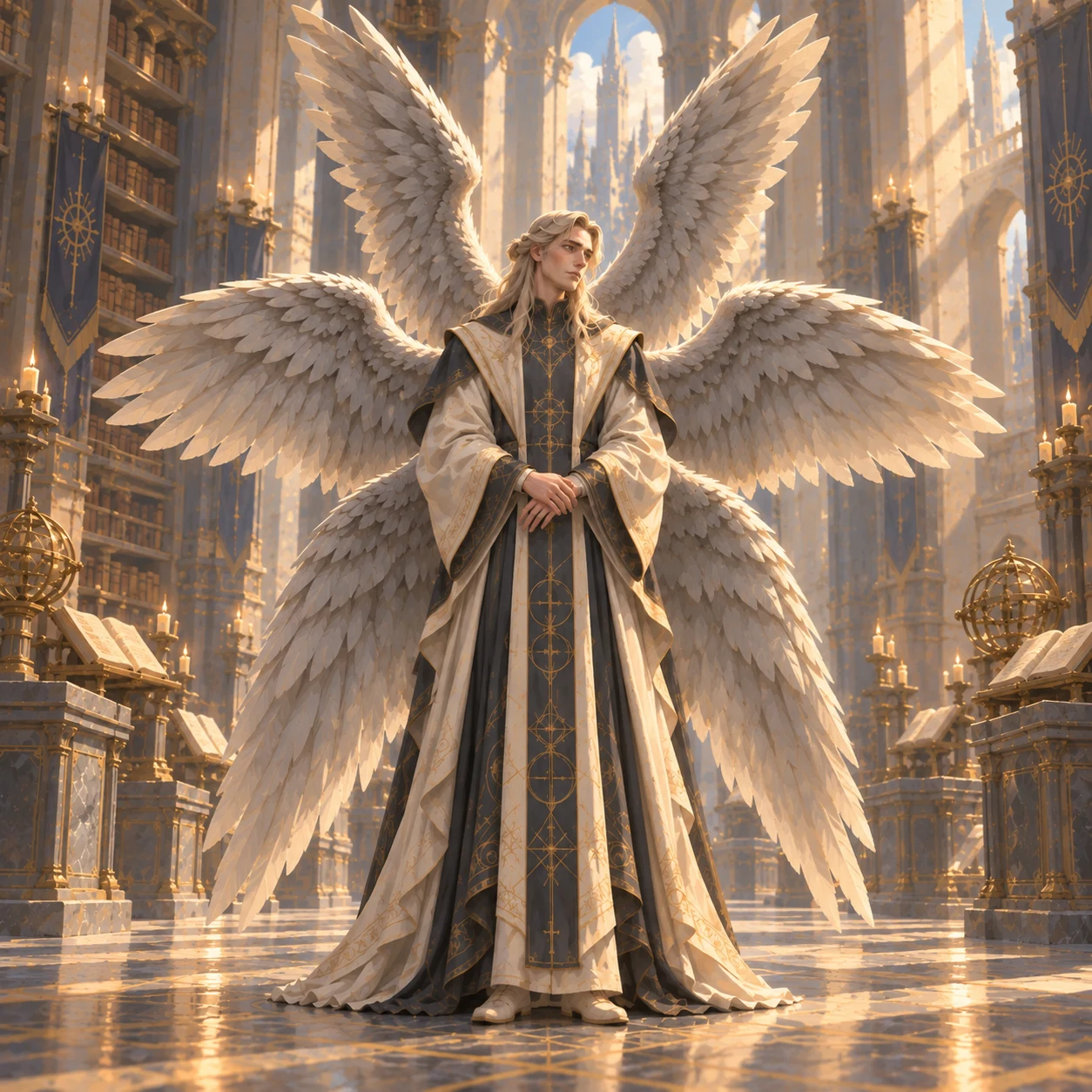
Metatron — painterly character concept, not an engine capture. Full concept and design notes.
The selected design gives Metatron three articulated silver-grey wing pairs, a specialized seraphic arrangement within the shared angelic nature. Folded, they enclose him in precise vertical structure; opened, the six distinct wings make the highest office-bearing angel's authority unmistakable. Metatron is the Voice of "God": the voice of Michael's engineered fiction before the real God exists, and later the voice that can become true when the player stands before him. His office does not place him above Samael, Michael's original equal outside the angelic bureaucracy. Measured unfolding can accompany his speech, while his face, pauses, and gentleness retain Enoch's human grief. This does not remove his ceiling or establish a new species or voice power. See Principal Character Visuals: Metatron.
Origin
Enoch was born human during the age when angels walked the earth and humans were still young. He was not exceptional by any external measure: no unusual lineage, no visible mark, no special role. He was a man who believed.
His faith came from both sources simultaneously: the religious framework AND direct angelic contact. The framework gave him the OBJECT of faith: what to believe in. Michael's engineering iterations provided the structure, the vocabulary, the direction. The encounter gave him the EXPERIENCE: why to believe. An angel appeared. Something divine was visible. The direct contact confirmed the framework in a way no scripture alone could.
Michael could control either in isolation. He controlled the framework: every religion was his engineering. He controlled the encounters: Heaven's cage limited angelic contact with Earth. But Enoch received both. Framework + encounter = faith that breaks the system. Either alone stays contained. Together they produce the one force Michael cannot fully control. Real faith grown inside a fabricated system. The system was Michael's. The faith was Enoch's.
And because human faith has no ceiling (no structural limitation, no engineering that caps its reach) Enoch's belief went further than any angel's ever had.
It reached Heaven.
The River caught every human who died: regardless of faith, regardless of virtue. The River's nature, not Michael's design. No human was supposed to reach Heaven. Heaven was family. Angels. Michael's home. Human essence was too unknown, too uncontrolled, too dangerous to the purity of the fiction.
Enoch's faith didn't care about The River's pull. His soul never entered the water. It went upward: toward Heaven: with enough force that The River's pull never caught it. Escape velocity. A human soul propelled by raw belief, moving so fast the oldest pull in existence couldn't hold what was already past it. He didn't enter The River and survive. He never entered at all.
This makes the parallel with God precise. Enoch escaped The River's pull. Outward faith, pointed at Heaven, moving past the water. God entered The River deliberately. Inward faith, pointed at the self and at The Kid, walking into the pull. Both override The River's nature. Both involve the human quality. The direction is opposite. Enoch went UP past The River. God went in.
A human soul arrived in Heaven. Michael saw it happen and recognized the threat. Not Enoch himself, but what Enoch demonstrated. Human faith can override the one force in the cosmology that even Michael is helpless before. Michael's inability to control The River isn't the ceiling. A human found a way past the thing Michael built his entire architecture around avoiding. Michael capped Enoch not to protect his "routing". He doesn't control The River, but to ensure no other human generates escape velocity from the one force that holds the dead. The ceiling he installed is about keeping humans from demonstrating that The River can be overcome by the one force Michael can't feel.
Michael couldn't send Enoch back. The angels had seen him arrive. He couldn't destroy him. The angels would ask questions. So he did what he did to Samael. He transformed him.
Enoch became Metatron. Human faith became angelic faith. The ceiling was installed. The potential was removed. The being who broke Heaven's door was remade into something that would never need to break anything again, because angelic faith operates within the system, not against it. The raw, unlimited, structureless belief that punched through Michael's routing was given structure, direction, and walls. Made manageable. Made safe.
The angels watched a human become the highest among ordinary angels and saw "God"'s grace. Michael watched a threat become contained and saw the system hold.
Personality
Before the Transformation (Enoch)
Lost. Enoch does not exist as a character the player meets. He exists only as the perspective inside Metatron: the human who was, before the conversion. What the player experiences through absorption:
- Simple. Enoch's faith was not intellectual. Not theological. Not structured. He believed the way breath happens: automatically, constantly, without thought.
- Quiet. Not a preacher. Not a prophet. A man who believed and lived accordingly. His faith did not demand an audience.
- Unaware. He did not know his faith was extraordinary. He did not know he was breaking anything. He reached Heaven the way a plant reaches sunlight, because that's the direction growth goes.
After the Transformation (Metatron)
- Dutiful. Metatron serves. The Voice of "God", the Scribe, the highest office-bearing angel. He performs his role with precision and without complaint. Whether this is devotion or programming is unclear: even to him.
- Distant. Something separates Metatron from other angels. A remove. A quality that reads as divine authority but might be something else: the ghost of a different kind of consciousness, filtered through angelic structure. Angels attribute it to his rank. It may be the last residue of being human.
- Grieving without knowing it. Metatron carries something he cannot name. An ache that has no angelic framework. A sense of loss that doesn't correspond to anything in his existence. He has never lost a sibling. He has never been exiled. He has never experienced the traumas that haunt Michael or Gabriel. But something is missing, and the architecture of his angelic mind has no category for it. The grief surfaces as stillness: long pauses, an attention that lingers on human souls in the River of Souls, a gentleness toward the young that other angels note but don't understand.
- Fractured. Not broken like Gabriel. Fractured in a quieter way. Two beings in one body. The angel who serves and the human who lingers. Metatron functions. Metatron is stable. But there are moments. A flash of something when he sees the merged world from Heaven's ruins, a hesitation before speaking Michael's name, where the seams show. Not enough to crack. Enough to sense.
The Conversion
Michael's pattern is conversion, not destruction. When a being achieves something that threatens the system, Michael doesn't kill it. He transforms it into something that can't threaten him anymore. The original is gone. A new version walks around.
- Samael discovered the truth. Achieved self-belief. Michael built Hell, wiped the memory. Samael became Lucifer: carrying the rage without the source. Self-belief surgically extracted.
- Enoch overcame The River's pull. Faith too powerful for anything in the cosmology to hold. Michael transformed him. Enoch became Metatron: carrying angelic faith where human faith used to be. The potential engineered out.
- Judas was built as a function without a recovered prior self. The Jesus-machine reading makes him a staged betrayer; the whispered and prophecy readings explain the scriptural correspondence without requiring that performance. Judas is what happens when Michael's pattern reaches its extreme: a function with no known identity underneath. Metatron has the ghost of Enoch. Lucifer carries Samael's wound. Judas has no equivalent record.
All three had different starting points. Samael and Enoch had the thing that matters and had it taken. Judas was never given it. Different methods: memory wipe, species conversion, absence by design. Same architect. Same pattern: the being becomes the role, and the role becomes permanent. Lucifer is Samael with the discovery removed. Metatron is Enoch with the humanity removed. Judas is a function with no person ever installed.
The transformation did two things to Enoch's faith. It removed the doubt. The human capacity to question, to hesitate, to wonder whether the framework is wrong. And it installed a ceiling. Angelic structure that limits how far the faith can reach. The result is faith that is simultaneously more blind and more bounded. More devoted and less capable of growth. The human safety mechanisms that kept Enoch's faith honest were stripped out. What remains is conviction without questioning: unfiltered, unchallengeable, absolute. Directed entirely at serving Michael's fiction.
Converted faith is not weaker faith. It is more dangerous faith. Enoch believed with the kind of uncertainty that comes with being human. Doubt that keeps belief honest. Metatron believes without any uncertainty at all. Gabriel's natural faith is bottomless but genuine. It grew on its own. Metatron's faith is bottomless because the part that could have limited it (doubt) was surgically removed. The blinder the faith, the better it serves.
Michael needed to control Enoch. A human with faith powerful enough to breach archangel-level engineering is not something the architect rewards. It is something he neutralizes. Same pattern as Samael. Someone becomes dangerous. Michael transforms them into something safe. But with Enoch, he went further. He didn't just neutralize the threat. He weaponized it. Took the most powerful human faith in existence and pointed it at himself. "The Voice of God". Enoch's faith now amplifies the God fiction instead of threatening it. The highest office-bearing angel is not less than what Enoch was in conviction. He is less in capacity. The ceiling prevents another breach. And he is less in freedom. The doubt that made Enoch human is gone.
The Severed Connection
Michael's cable-cutting pattern applies here in full: Enoch's human memories are intact. Enoch's real faith is intact. The cable is severed. Both ends of the cut survive.
Echoes bleed through the severed connection. The grief Metatron cannot name. That's Enoch. The stillness around human souls. That's Enoch. The hesitation before speaking Michael's name. That's Enoch's real faith vibrating against the artificial structure. And this is why Metatron can believe Gabriel when Gabriel says the player is God. The artificial faith alone couldn't process a real God showing up. Converted faith serves the fiction with precision. But a real God standing in the room is not what the fiction described. It's the echoes of Enoch's real faith that resonate with Gabriel's confirmation. The genuine faith, bleeding through the severed cable, recognizing the genuine God.
The cable can be repaired: only by God, using The Kid's power. Absorption takes in the severed connection. Creation joins the two ends back together. God can restore Metatron to Enoch.
Restored Enoch is grey. Unlimited real faith. Reconnected, alive, the ceiling removed, the doubt returned. But faith in what? The fiction that was his framework? Or the real God who restored him? Enoch's faith broke Heaven when it was pointed at "God". A fiction. What does that faith do when pointed at a real God? And the doubt returns with the faith. Enoch would question again, wonder again, hesitate. The human mess that made him dangerous. The restored being is more powerful than either Enoch or Metatron alone. Because the restoration doesn't erase the conversion, it adds back what was cut. Both experiences in one being. The question is whether Enoch with both experiences is something the cosmology has a framework for.
If a literal Jesus machine existed and Enoch came first, Michael may have learned from the failure: strip doubt from the next build and fabricate faith instead of growing it. Metatron's conversion and the possible machine may share an engineering lesson. The machine's existence, its date, and Enoch's position relative to it all remain unresolved, and Metatron cannot recover the missing human memory.
He was still wrong about what made Enoch dangerous.
The threat was never how far faith reaches outward. Enoch's faith was extraordinary but still pointed at "God," at Heaven. External. It broke engineering but it wasn't self-belief. The real danger. Faith directed inward, at the self is something Michael cannot conceive of because he cannot feel it. Self-belief doesn't project. It doesn't power external systems. It doesn't break routing. It doesn't register on any instrument Michael built to monitor the universe. It is invisible to the architect.
Michael capped the visible threat and remained blind to the invisible one. He contained external faith. Its power, its reach, its capacity to break engineering. Self-belief didn't register on anything he built. Whether the engineer who understood external faith better than anyone could have recognized a force his instruments weren't designed to detect. Is the question the game never answers.
The Deception
Enoch's arrival created a problem Michael had to solve. The angels believed the fiction. God exists, the faithful are rewarded, worthy human souls ascend to Heaven. But no human souls ever arrived. The River caught them all. Every human soul pulled into the current, none reaching Heaven. The angels would eventually notice.
"Father promised the faithful would join us. Where are they?"
Michael used Enoch as the answer. The transformation became the cover story:
"Look at what it took. Enoch's faith was unprecedented, and even he had to be transformed to withstand "God"'s presence. Humans are young. Their faith is developing. The standard is that high."
The angels accepted this because it confirmed what they already believed. The hierarchy is real. Angels are inherently worthy, humans must prove themselves. The system works. Enoch made it. The promise holds: more will come when they're ready. And it came from the brother they trusted.
The standard isn't high. It's impossible. The River catches every human who dies regardless of faith, and Michael can't override its pull. Enoch was an anomaly. Faith so powerful it broke the system, and Michael converted him to plug the hole. The "standard" he sold the angels is fiction layered on fiction. The promise of Heaven for humans was never real.
The full deception chain: The River catches every human who dies → No human souls reach Heaven → Michael calls this "routing" and sells an impossible standard → Angels sincerely teach humans that faith leads to Heaven → Humans believe sincerely and strive for an afterlife they can never reach → Every human who ever died went to the water believing they'd earned the sky. Everyone in the chain is sincere except the one at the top.
The River of Souls
Metatron has existed in Heaven since before the rebellion. He has watched the River of Souls from above: the stream of human dead flowing through Hell's architecture. Whether he understands what he's watching depends on how much of Enoch survives inside him.
If the human memory is gone: Metatron sees the river the way angels see it: souls in "God"'s plan, each in their appointed place. He doesn't question why they're in Hell rather than Heaven. The theology explains it. The standard is high.
If fragments remain: Metatron looks at the river and feels the unnamed grief. Those are his people. He was one of them. They were promised Heaven and they went to Hell. He made it out (or he was pulled out) and they didn't. The gentleness he shows toward human matters, the stillness when human souls are discussed, the hesitation: it's Enoch, looking down at the river, not understanding why he's the only one who crossed.
Metatron and the Player
The Veil (Circle 3)
The player finds Metatron at Circle 3. The Veil. The boundary that separates kinds. The circle Michael placed him in. Trophy and warning. The being who crossed the boundary, stationed at the boundary he crossed.
The player finds Metatron at Circle 3. The Veil. An encounter, not a companionship. The Voice of God stationed at the boundary he crossed. Trophy and warning. The puppet who doesn't know he's a puppet, the voice speaking words for a being who doesn't exist.
Metatron is what Michael built him to be. Warm, dutiful, welcoming. He gives the official story. He speaks the fiction with absolute conviction, because his converted faith allows nothing else. The doubt that might have made him pause, question, recognize the player for what they are. That was stripped in the conversion. He serves. He performs the role of the Voice of God for a God that isn't real. The player sees the cost of conversion from the outside: the official story delivered by a being whose title is a collar. Then the player moves on alone.
Metatron is the player's mirror in a way no angel can be. Michael, Lucifer, Gabriel. All started as angels. They were never human. They don't know what the player is losing or gaining. Metatron does. He was human. He had the raw faith, the no-ceiling potential, the same starting material. And Michael got to him first. Converted him, capped him, installed the ceiling, removed the doubt. Metatron is what happens when the architect catches a human becoming something more. The player is what happens when he doesn't.
The Confirmation (Circle 6)
At Circle 6 (the Anchor) Gabriel waits. He has been here. Patient. Anchored. The angel who has been sensing the return of "God" for eons, stationed at the circle of Patience because patience is what he's been doing.
Metatron is already here. He came independently. Not following the player, but needing the same answer. The Voice needs the Eyes. Converted faith can serve but cannot recognize. Metatron is the Voice of God. But a voice needs someone to tell it who to speak for. His blind, converted faith is absolute, but it cannot identify God. Converted faith may only see one aspect of the tribrid. The angel nature, perhaps, or none of them clearly. The human part that could have sensed something real was stripped in the conversion. The doubt that made Enoch human. The capacity to look at a tribrid carrying three natures and feel the whole rather than the pieces. Is gone. He needs Gabriel's genuine faith. The real kind, the kind Michael cannot build and cannot feel: to confirm what his converted faith cannot determine on its own.
Gabriel looks at the player, a tribrid carrying three natures that the major factions read as contradiction. His genuine, unengineered faith sees past the parts. Where angels sense the angel and recoil from the demon, where demons sense the demon and recoil from the angel, and where humans feel the gap, Gabriel sees the whole. The Kid accepted the person before categories mattered. Gabriel is the first major post-Eden witness to recognize all three natures through a theological framework and celebrate what they compose. Gabriel would never lie about "God". If Gabriel confirms, it is the most reliable confirmation Heaven can produce. Not proof. Faith. But faith that means something because it cannot be faked.
The Freedom
Gabriel's confirmation frees Metatron.
Every act Metatron has ever performed was for a fiction. The Voice of God speaking for a God that didn't exist. Every message relayed, every prayer answered, every moment of service: pointed at nothing. His title was a collar. "The Voice of God" actually meant "The Voice of Michael." He was forced to speak another being's words, protect another being's fiction, amplify another being's narrative. Not by choice. By conversion.
Gabriel's confirmation changes the object. For the first time in Metatron's existence, God is real. The player is standing in front of him. And his title (the collar, the fiction, the forced identity) becomes true. "The Voice of God" finally means what it says. Not Michael's voice. God's voice. The collar becomes a name. The fiction becomes an identity.
The revelation doesn't remove the conversion. The doubt is still gone. The ceiling is still installed. The architecture of his faith is still Michael's work. But the purpose of that architecture just became real. The cage didn't open. The cage became a cathedral. Same structure, different meaning.
The Greatest Sacrifice
Metatron offers himself to the player.
Not because Michael built him to give. Though he did. Not because the converted faith completes its function. Though it does. Because for the first time, the sacrifice means something. Every previous act of service was to a fiction. This one is to "God". The Voice of God gives itself to "God". The first real choice Metatron has ever made, and he chooses to surrender the first true thing he's ever had.
He could finally be the Voice of God. Truly. Actually. For the first time. His title is real. His purpose is fulfilled. His identity finally matches his name. And instead of claiming that (instead of finally living as what he was always called) he offers it all. He gives up the first moment of truth in his entire existence.
The player chooses.
Absorb: The greatest sacrifice accepted. The Voice of God lives inside God: his voice is God's voice now, in the most literal sense. Inside the player, Enoch's faith lives on. The most powerful human belief ever produced, carried by the being it was always meant for. The sacrifice is simultaneously the greatest loss and the greatest fulfillment. The player decides which.
Refuse: The player leaves Metatron alive. Free. His title real for the first time. The first genuine choice Metatron ever made, and the player respected it by refusing. But Metatron is still in Heaven. Still inside Michael's architecture. What happens to him when the player moves on? Does freedom mean anything inside the cage?
Neither is right. Neither is wrong. The game doesn't answer. The player carries the weight either way.
The ambiguity the project demands is still there. Was the freedom real, or was it the most perfect expression of the cage? Metatron believed he was choosing freely. The faith felt real. But the architecture of that faith was still Michael's work. Did Gabriel's confirmation genuinely free him, or did it just give converted faith its most convincing target? The player can't know. Neither could Metatron. And the game never answers.
The Absorption
If the player absorbs Metatron, they gain something no other absorption provides: the experience of being human and then not. The transformation felt from the inside.
The player lives Enoch's life. The quiet faith. The slow reach toward something he couldn't name. The moment faith broke through: the overwhelming sensation of arriving somewhere impossible, of standing in a place no human was supposed to see. And then the conversion. The doubt stripped away. The ceiling descending. Human faith compressed into angelic structure. The moment unlimited became limited. What it feels like to have questioning become certainty. To have raw become refined. To have human become angel.
The player, who is going the opposite direction (human becoming God) experiences the reverse trajectory. Two transformations in opposite directions, felt simultaneously. Metatron is the road not taken. The player absorbs the warning and carries it forward.
The player also absorbs the River of Souls knowledge: what Metatron has watched from above. The human dead. The current that catches them. The truth about where the faithful go. If the player hasn't reached Hell's river yet, this is foreshadowing. If they've already searched for The Kid and failed, this confirms: the river holds the normally dead. Absorption takes you somewhere else entirely.
Relationship with Michael
Metatron has existed alongside Michael since the transformation. The highest office-bearing angel and the architect. The Voice of "God" and the inventor of "God".
Their relationship is defined by the gap between what Michael did and what Metatron knows. If the conversion was total (if Enoch is fully gone) then Metatron is simply the most faithful angel. He serves Michael's fiction with the same sincerity Gabriel does, from a higher position. Michael sees a successful containment. Metatron sees a beloved brother.
If fragments remain. Metatron may sense something wrong about Michael. Not the truth. Not the fiction. Just a dissonance. The way Michael speaks about "God". The way Michael handles questions about the River of Souls. A feeling that the architect knows more than he shares. Enoch's human intuition. The thing that reached Heaven: may still be reaching. Toward what, Metatron can't say.
Michael's relationship with Metatron is simpler and more terrible. Michael sees his own handiwork. Every time he looks at Metatron, he sees Enoch: the human he broke, the faith he capped, the potential he removed. Whether this produces guilt, satisfaction, or the same grey mixture that defines everything Michael does is never confirmed. Michael contained the threat. The containment walks around Heaven performing duties with quiet precision. The engineer watches the converted being and sees a problem that was solved.
Relationship with Gabriel
Metatron and Gabriel share the same structural limitation (bottomless faith, all pointed outward) but arrived there by different roads. And those roads define the difference between them.
Gabriel was always an angel. His outward orientation is original. His faith is genuine: it grew on its own, natural and unengineered. The denial sealed what was already there. He never had the option of pointing faith inward because he was never built with that capacity. But his faith can do something Metatron's cannot: recognize. Gabriel's faith is the antenna. It reaches farther than any other level of the unified system. It detected God's birth before anyone else could sense it.
Metatron was human. His outward orientation was installed. He had the option. It was removed. His faith is converted: the doubt stripped, the ceiling imposed, the conviction made absolute by removing everything that could limit it. Converted faith is blinder than natural faith. It can serve with total devotion but cannot independently identify what it serves. Gabriel's prison is native. Metatron's was constructed. Gabriel can see. Metatron can only follow.
This is why Metatron needs Gabriel. The Voice of God needs the eyes of God. Metatron can speak for the divine but cannot recognize the divine standing in front of him. Gabriel can recognize what his faith has been sensing, and does. At Circle 6, Gabriel's genuine faith confirms the player is God. The confirmation Metatron's converted faith could never produce on its own. The voice needs the believer to tell it who to speak for.
Gabriel sees Metatron as the angel closest to God. The proof of his theology. If Gabriel understood what Metatron really is. The Voice of Michael, not the Voice of God: the implications would fracture his framework. But Gabriel's confirmation transforms the title. After that moment, Metatron is the Voice of God. Gabriel's faith made the fiction true. The same pattern as everything else in this story.
Themes
- The collar that becomes a name. "The Voice of God" is a fiction: Metatron is the Voice of Michael, forced to speak another being's words. Gabriel's confirmation makes the title true for the first time. The collar becomes a crown. Whether Metatron then surrenders that crown is the player's decision to witness.
- Converted faith is blinder, not weaker. Michael didn't reduce Enoch's faith. He removed the doubt. The result is faith more absolute than Gabriel's, because Gabriel's grew naturally and Metatron's was engineered to be unchallengeable. The blinder the faith, the better it serves.
- Faith as the uncontrollable force. Enoch's faith broke Michael's engineering. Gabriel's faith detects God's birth. The player's faith reaches the Boundary. Michael can build systems that run on faith but cannot control what faith does when it moves on its own.
- Michael's blind spot. He capped Enoch's external faith because that's what he perceived as dangerous. Self-belief (the actual threat) is invisible to him. The engineer's surveillance system has one blind spot, and it's the only thing that matters.
- The stolen potential. Samael and Enoch: both had the thing that leads toward God. Both had it taken by the same architect. Different methods, same result. Michael's defining move is conversion, not destruction. But with Enoch he went further: he weaponized the threat. The Voice of God is Michael's most effective tool, built from the most powerful human faith in existence.
- The road not taken. Metatron is the player's inverse. Same starting point: human, faith with no ceiling. Opposite outcome. One was caught and capped. The other wasn't. The player absorbs the warning.
- The greatest sacrifice. Metatron's offer is the first real choice he has ever made. The first time his faith serves something real. He gives up the first true thing he's ever had, and the ambiguity of whether that choice is genuinely free or the final function of the cage is the player's question.
- The grief without a name. Metatron carries something that doesn't fit his angelic existence. The last residue of Enoch: human consciousness inside an angelic shell, grief without a framework, loss without a category. The ghost in the machine.
- The cable, not the hardware. Michael severs connections but doesn't destroy what's connected. Everything Enoch was is still there: intact, disconnected, bleeding through. The echoes are the proof. The grief is the signal. The restoration is possible because destruction was never Michael's method.
- Dual-source faith. Enoch's faith came from both the fabricated framework and genuine angelic contact. Michael could control either alone. The combination produced something uncontrollable. Real faith grown inside a fake system: the pattern that breaks every engineer's model.
- The Enoch prophecy. Scripture records Enoch's ascension as history: a human taken by God and installed as the highest office-bearing angel. Everyone reads it that way. Only Gabriel reads it as prophecy about the player. Both readings are true, but the phrase "raised above all angels" is institutional language in the historical account: Enoch was raised above ordinary angels into the highest office, while Samael and Michael remained outside that bureaucracy. The passage is history (it happened to Enoch) and prophecy (it describes God: a human who can rise beyond every angel). The grey: the last time this prophecy was "fulfilled," it cost Enoch everything. The faithful see the reward. The cost is invisible to faith.