Gabriel
Titles
- Before the merge: Angel of Faith
- After the merge: The Prophet
Overview
Gabriel is the center of the story that no one is watching: a being with deep faith who followed the brother he trusted most into deicide, and could not accept what he'd done. A believer who broke and rebuilt himself around denial so complete that it became indistinguishable from conviction.
He prophesies the return of "God". God was never here before. His prophecy is wrong about the past but accidentally right about the future: God is being born for the first time. Gabriel senses something real through the only framework he has, and misinterprets it completely. Just like every prophet in history.
Visual Identity
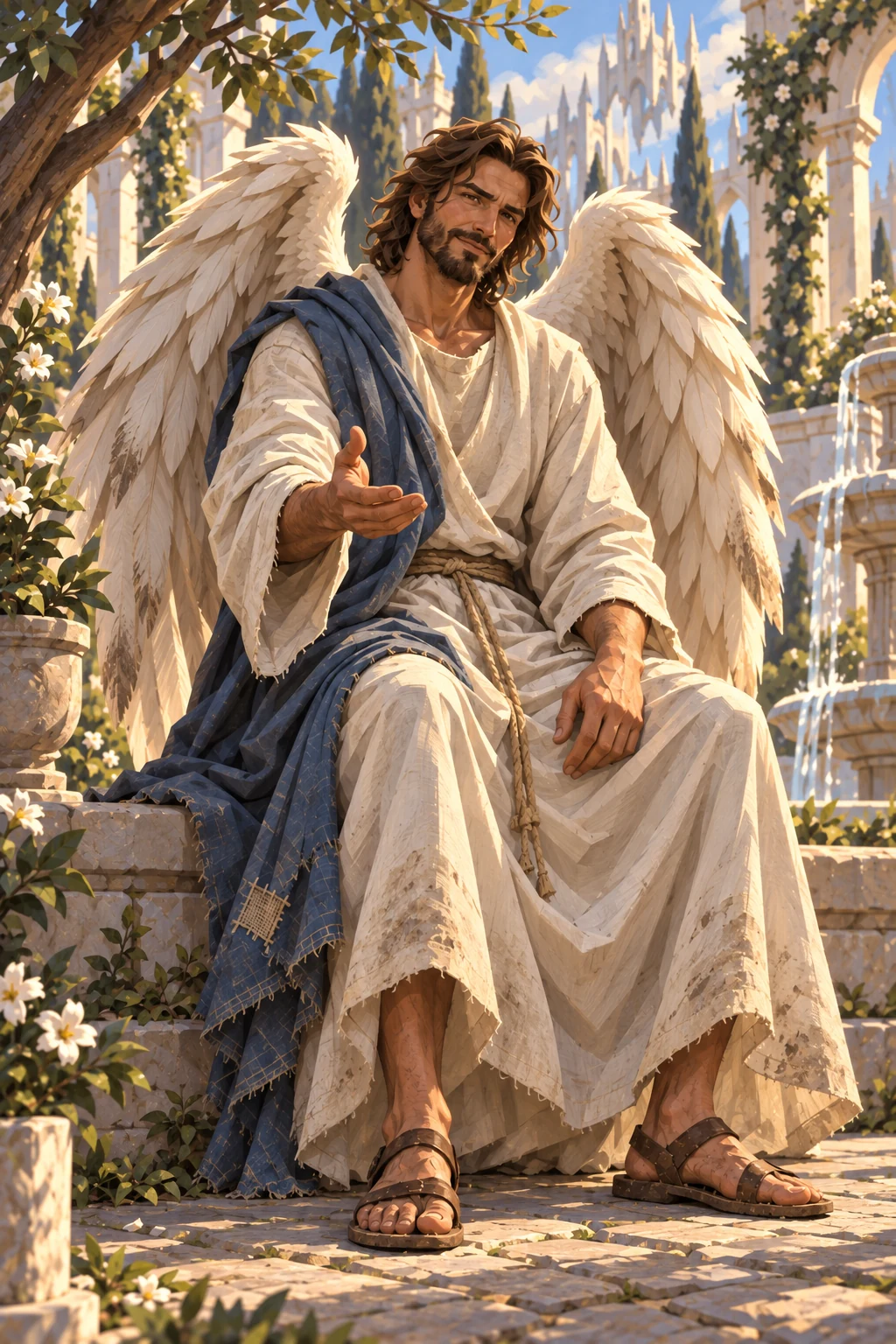
Gabriel — painterly character concept, not an engine capture. Full concept and design notes.
Gabriel's single broad wing pair has soft, enveloping contours and warm cream treatment in the selected concept. Weathered linen, a repaired blue mantle, dusty sandals, tousled hair, and an uneven beard make him approachable and human-readable without removing his angelic beauty. Relaxed folds, patient gestures, and a grounded stance make him visibly at home in Heaven's beauty. His wings remain functional anatomy during ordinary life, not a concealed transformation. See Principal Character Visuals: Gabriel.
Origin
Gabriel was born during the Age of Angels: created by Michael as part of the growing family that Samael asked for. He was not built as an equal. He was not built with a special purpose. He was built with faith.
Where other angels developed theology, hierarchy, and resentment, Gabriel developed devotion. He loved the absent father simply and completely. He didn't need "God" to appear. He didn't need proof. He believed because believing felt true. Of all the angels, Gabriel's faith was genuine in a way no other angel's was, which made it the most exploitable.
Personality
Gabriel before the merge and Gabriel after the merge are the same being filtered through trauma:
Before the Merge
- Sincere. Gabriel doesn't perform faith. He lives it. Other angels have doubts they suppress. Gabriel has none. This makes him trusted, and vulnerable.
- Loyal. His loyalty is to family above all. He loves his brothers. He trusts Michael as the eldest, the steady one, the firstborn who always knows what to do.
- Gentle. Gabriel is not a warrior by nature. He is a voice: someone who speaks, encourages, comforts. The angel others go to when they need reassurance.
- Naive. Not stupid. Naive. He sees the best in everyone because his faith extends beyond "God" to every relationship he has. He cannot conceive of being deliberately deceived by someone he loves.
After the Merge
- Fervent. The gentleness is gone. Replaced by intensity. Gabriel preaches with a fire he never had before, not because his faith grew, but because his denial demands constant fuel.
- Unyielding. He cannot tolerate doubt. Not in others, not in himself. Questions are threats. Skepticism is danger. Every challenge to his prophecy is a challenge to the only thing keeping him sane.
- Charismatic. His sincerity: the same sincerity that made him the Angel of Faith: now makes him the most convincing voice in the merged world. People follow him because you can't fake that kind of conviction. He's not faking it. He's broken.
- Fragile. Beneath the fervor is a being held together by a story he tells himself. The structure is rigid because it has to be. One crack and everything collapses. Gabriel isn't strong. He's brittle.
The Rebellion
Gabriel joined the rebellion because Michael did.
Not because of rage like Lucifer. Not because of theological grievance like other angels. Because his eldest brother (the one he trusted most, the firstborn, the steady one) stood up and said it was time.
Whatever Michael was doing (performing, desperate, uncertain) it hit Gabriel hardest. Whether Michael projected conviction he didn't feel, or carried an uncertainty he couldn't voice: Gabriel absorbed it completely. If Michael stands against "God", then it must be right. Michael wouldn't lead them wrong.
Gabriel raised his hand against the being he loved most in existence because the brother he trusted most stood beside him. Gabriel was sincere. What Michael was (performing, uncertain, desperate, some combination the docs don't confirm) doesn't change what Gabriel experienced. The sincere one carries the guilt. Michael walks away.
This is the cost. Whether Gabriel was in Michael's calculation (whether Michael saw what this would do to the most trusting member of the family and couldn't prevent it, whether he missed it entirely, whether his mind doesn't model that kind of consequence) is never confirmed. The result is the same either way.
The Denial
"God" explodes. The realms merge. Heaven is gone. Hell is fused into the earth. Everything Gabriel believed is destroyed in a flash of light.
Gabriel cannot accept this.
The Angel of Faith cannot be the angel who killed the thing he believed in. The contradiction is too large. His mind will not hold both truths: that he had pure faith and that he participated in deicide. Something has to give.
Faith stays. Reality goes.
Gabriel rewrites what happened:
- "God" isn't dead. "God" is testing them.
- The explosion was ascension, not death. "God" chose to leave.
- The merge is part of "God"'s plan. They didn't destroy anything. They fulfilled prophecy.
- Michael's disappearance proves it: "God" took He Who Is Like God with him. Reunited with the Father.
This isn't deception. Gabriel believes every word. The seam between truth and denial fused so completely inside him that he can't tell them apart anymore. He didn't choose to deny reality. His mind chose for him, because the alternative was annihilation.
The Load-Bearing Word
Gabriel says "return." Never "birth." This is the single most important word in his theology: the word that holds his identity together.
Follow what "birth" would mean:
- If God is being born: God is new. God never existed before.
- If God never existed before: the rebellion killed nothing. There was nothing to kill.
- If the rebellion killed nothing: Gabriel raised his hand against emptiness.
- If Gabriel raised his hand against emptiness: Michael led him into an act of violence against nothing.
- If Michael led him into violence against nothing: Michael either deceived him deliberately or was as lost as everyone else.
- Either way (Gabriel's faith, his loyalty, his identity as "the one who believed," his participation in the most violent act in the cosmology) was all in service of nothing.
"Return" preserves the chain at step 1. If "God" existed before and is now returning, then the rebellion had a target, Gabriel's participation was meaningful, Michael's leadership was genuine, and Gabriel's faith served a real object. His identity survives.
"Birth" kills Gabriel at step 6. The being who defined himself entirely through faith in something external discovers that the something was never there. His participation in deicide was participation in an act against emptiness. The brother who led him into it was either the architect of the fiction or as blind as Gabriel was. Gabriel's entire existence was in service of nothing.
Gabriel can't say "birth" for the same reason he can't say "Michael": the word triggers the collapse his denial exists to prevent. "Return" is the word that keeps him alive. He says it from every pulpit. The congregation hears theology. The truth is a survival mechanism performing as doctrine.
And the cruelest layer: Gabriel's antenna IS real. The signal IS real. He genuinely senses God approaching. The instrument functions perfectly. But the operator can't read the output correctly because reading it correctly requires accepting that the previous reading was aimed at nothing. He receives "something divine is approaching" and interprets it as "the being who left is coming back", because "a new being is being born for the first time" would collapse the interpreter. The most accurate prophet in the cosmology AND the most inaccurate interpreter of his own prophecy.
The Deeper Loyalty
Underneath the denial, underneath the chain, underneath "return" protecting against "birth" is the reason Gabriel participated at all.
Gabriel joined the rebellion because Michael did. Not theology. Not rage. Not grievance. Because the brother he loved stood beside him and said it was time. When the real test came (not the sermon test, not the Sunday faith test, the real test) Gabriel chose Michael over "God". His love for his brother was stronger than his faith in the divine.
Gabriel loves Michael more than God. That's the answer he already gave. He just can't see it.
The denial isn't just hiding what Gabriel DID. It's hiding what his action REVEALS ABOUT HIM. If Gabriel sees that he chose Michael over "God", he confronts: his faith was never his deepest loyalty. His love for his brother was stronger than his love for the divine. The being he followed into deicide was more important than the being he killed. His entire identity (the Angel of Faith) was secondary to a love he never named.
Every time Gabriel says "He Who Is Like God" from the pulpit, he's saying the name of the being he loves most. The congregation hears theology. The truth: the most faithful angel in existence is publicly declaring love for his brother in a language his mind can survive. The entire post-merge Church is a love letter to Michael disguised as a prayer to "God".
Gabriel could survive The River. The love for Michael (genuine, unchosen, deeper than faith) would survive the stripping. But Gabriel would never enter. The person he loves most told him not to: through the fiction, through the warnings, through the culture of Heaven that made the water forbidden. And Gabriel lacks the darkfire. One nature. One coin with a ceiling. Even if the love survived, the four-heritage transformation is structurally impossible. The tragedy: Gabriel has the love. He lacks the mark. And the person he loves is the reason he'll never test either.
He Who Is Like God
Gabriel cannot say Michael's name.
He refers to him only as "He Who Is Like God." Always the title. Never the name. In every sermon, every prophecy, every conversation: He Who Is Like God. It sounds theological. It sounds reverential. It sounds like scripture describing a figure who stands at "God"'s right hand.
It is anguish dressed as doctrine. And it is Michael's name (the literal meaning of it) spoken in a form that doesn't hurt as much. Gabriel is saying his brother's name every time he preaches. He's using the translation, not the word. The congregation hears a theological title for a divine figure. Gabriel is saying "Michael" in a language his mind can survive.
The irony runs deeper. The title reads as confession. Or as a comparison Michael himself can't resolve. "He Who Is Like God". Because he built the fiction, or because he genuinely doesn't know the difference. Every time Gabriel repeats it from the pulpit, he is unknowingly repeating something Michael embedded in the name. Whether that's a hidden admission or an unresolved question, the echo is the same. The fiction speaks through the mouth of the believer who trusted him most.
Gabriel doesn't acknowledge this is pain. He may not consciously know it is. The avoidance is so total, so integrated into his theology, that it looks like reverence. "He Who Is Like God was taken by the Father. He Who Is Like God stands at "God"'s side. He Who Is Like God will return with "God"." Every sentence is a prayer. Every prayer is grief.
The player hears "He Who Is Like God" throughout Acts 2 and 3. It sounds like any other piece of Gabriel's theology. A title for a holy figure close to the divine. The player doesn't realize it's a specific person's name until Lucifer's absorption in Hell reveals the truth. And "He Who Is Like God" collapses into "Michael." Every sermon replays. Every trembling reference recontextualizes. Gabriel wasn't preaching about a theological concept. He was talking about his brother. He was saying the name without saying it.
Whether Gabriel can ever say "Michael" (drop the title and use the name) is the measure of whether he's broken or healing. The game never forces this moment. It either happens or it doesn't.
The Prophet
Gabriel builds a new theology around his denial. A post-merge religion. "God" is not dead. "God" ascended. The merge is not a catastrophe. It is the next chapter. The faithful will be rewarded. "God" will return. He Who Is Like God stands at the Father's side.
Because he is the Angel of Faith (the most trusted voice among the angels) others believe him. In a shattered world, Gabriel offers certainty. Purpose. Hope. People don't follow him because he's powerful. They follow him because he believes with a conviction that cannot be performed. You can't fake what Gabriel has. He's not faking it.
He becomes the most influential voice in the merged world. His following grows. Temples are built. Scripture is rewritten to support his prophecy. A new church rises from the ashes of the old world, and Gabriel is its center.
He is a false prophet who doesn't know he's false. The most dangerous kind. Someone who is wrong with the conviction of someone who is right.
The Prophecy
Gabriel has always felt it.
Not just after the merge. Not just after the denial rebuilt him. Always. During the golden age, before the rebellion, before everything fell apart: Gabriel felt something approaching through the unified system. A presence. A trajectory. Something the math of existence was pointing toward. He didn't have a framework for it then. He didn't know what he was sensing. He just knew his faith reached toward something real beyond the absent father.
The merge amplified the signal. The denial gave it a framework. But the signal was always there. Gabriel was the Angel of Faith because he was the one most attuned to the system's trajectory. The unified system always contained the math that would produce God: Samael built as an equal, the inevitable discovery, the inevitable rebellion, the inevitable accidental creation. Faith sensed the inevitability. Gabriel felt something approaching his entire existence without knowing what he was feeling.
Gabriel preaches three prophecies. Connected but distinct. All from scripture. All treated as settled history by everyone except him.
The Jesus prophecy: The full arc. Born in humble circumstances, walked among ordinary people, betrayed from within, sacrificed himself. What God will do. The birth, the betrayal, the sacrifice, the path. Every priest reads this as past tense. A completed story about a completed life. Gabriel reads it as unfinished. The Judas element is embedded inside the narrative. The betrayal from someone close, the blind spot, the intimate treachery that leads to the sacrifice. Everyone hears it as part of the Jesus story. Nobody separates it out as a warning. The truth: God's Judas is not a person. It is absorption itself. The mechanism God depends on, the blind spot that cannot be examined. The scripture warned the player. The warning was hidden in plain sight inside a story everyone already knew.
The sacrifice the scripture describes is The River. The willing death. Entering the most dangerous place in existence, not knowing if you'll survive, for love. Faith producing the act that earns divinity. The cross. Humans wrote this prophecy and humans understand sacrifice through incomplete information. Risk, love, willing death. The scripture is accurate about the human sacrifice because it was written by humans.
The scripture is silent about the Throne sacrifice: the sacrifice made with complete system-internal information, where God sees every established cost and existing perspective before choosing. Humans cannot conceive of sacrifice with that completed record while the reactions of free beings remain unwritten. The prophecy captures what the human does. It has no framework for what God does after. Gabriel preaches the sacrifice as the culmination. The truth is that the sacrifice is the midpoint. What God chooses at the Throne with the full existing record is beyond the prophecy's reach.
The Alpha and the Omega: "The beginning and the end." What God is. Not just a title. A nature. The complete being. The one who carries everything. Gabriel fixates on this passage because it describes what his faith is sensing. Not just a birth approaching, but a nature. Something total. Something that encompasses.
The Enoch prophecy: "The faithful shall be raised above all angels." Everyone reads the Enoch passage as history. A human who walked with God and was taken up, who became the highest office-bearing angel among ordinary angels. Metatron's origin story. Settled. Past tense. Only Gabriel reads it as prophecy. A human who will be raised above all angels. A mortal who will surpass everything Michael built. He sees the pattern: faithful human, taken by God, elevated above the hierarchy. He reads it forward, not backward.
He's right about all three. But not in the way he thinks.
God was never here before. There is nothing to return. What Gabriel senses is not a homecoming. It is a birth. The player, born in a village with a birthmark and the ability to absorb, is "God" coming into existence for the first time. And the Alpha and the Omega is truer than Gabriel can imagine. The tribrid who carries all three races, the end of the old order and the beginning of something new. God is the Alpha not because God was first, but because God is the starting point of whatever comes next. God is the Omega not because God is the last, but because God is where Michael's architecture ends. The end of the old and the beginning of the new in one being.
And the Enoch prophecy is literally true. God is a human raised above all angels. Not metaphor. Not theology. A human born in a village who becomes the highest being in existence. The prophecy described what happens. And what happens is what God is. But the grey is built into the history. The last time "a human raised above all angels" happened, it cost Enoch everything. His real faith, his memory, his identity. He became Metatron. The highest office-bearing angel in Heaven, while Samael and Michael remain outside that bureaucracy as equals. The most caged being in it. "Raised above all angels" is simultaneously the most beautiful promise in scripture and the most devastating thing that ever happened to a human.
Gabriel reads the Enoch passage and sees the player's destiny. He sees the reward. He does not see the cost. The faithful see reward. That is the nature of faith, and it is also a sin. The assumption that you understand God's plan. The certainty that the beautiful reading is the correct one. Gabriel's greatest virtue. Bottomless faith (produces the deepest sin) the pride of comprehension. He lives in Heaven, the most beautiful cage ever built, and sees the beauty. He hears "raised above all angels" and hears glory. He doesn't hear the lobotomy. He can't, because seeing the cost would require seeing what Michael's system actually does to people, which would require seeing the fiction, which his denial exists to prevent. The virtue is the vice. Same circle, different name.
Gabriel is the only being in the world who reads all three passages as prophecy rather than history. Everyone else (humans, angels, demons) treats the Jesus story as a completed event, the Alpha and Omega as a description of the "God" who is already gone, and the Enoch passage as a settled origin story for Metatron. Past tense. Settled. Gabriel senses none of it is finished. He reads the same text everyone else reads and feels the future in it, not the past. Everyone thinks he's reinterpreting settled history to justify his denial. He's the only one reading it correctly, and nobody believes him.
The player hears both titles throughout Acts 2 and 3. "He Who Is Like God". Gabriel's grief about his brother, dressed as doctrine. "The Alpha and the Omega". Gabriel's prophecy about "God", dressed as scripture. Two phrases. One looks backward at Michael. One looks forward at the player. Gabriel doesn't know they're causally linked: Michael's fiction created the being the prophecy describes. The brother's actions produced the God.
"He Who Is Like God" collapses into "Michael" after Lucifer's absorption in Hell. "The Alpha and the Omega" collapses into the player's own identity. The moment they realize Gabriel was describing them. "The faithful raised above all angels" collapses when the player becomes God. The prophecy fulfilled in the player's own transformation. Three revelations. Three different moments. Same prophet. Same unknowing truth.
Gabriel's prophecy is wrong about the past and accidentally right about the future. Just like Michael's fiction became truth, Gabriel's denial becomes prophecy. The pattern repeats: fiction writes itself into reality.
This validates the unified system. Faith works. It's imprecise, filtered through bias and denial, but it reaches toward something real. The universe produced again: in the moment every angel and demon cried "where is "God"?" Whether the universe heard the plea and responded, or the mechanism produced what it produced when conditions aligned, is unknowable. Either way, Gabriel's faith detected the production before anyone else sensed anything. He is the most faithful being alive, and his faith operates on the same mechanism the universe's production operates on. His faith was the first antenna to pick up the signal.
But Gabriel's faith points in one direction. Outward. The Boundary responds to faith in both directions: self-belief and faith in something beyond. Gabriel has the strongest outward faith in existence. He has zero self-belief. His identity is the act of believing in something external. The strongest antenna alive, permanently pointed away from the one target that would complete the signal. If Gabriel ever turned that faith inward. But he can't. His mind built itself to never look there. He just couldn't interpret the signal cleanly because he's working with the lowest level of the system. Real data through broken equipment. But the signal was strong enough to produce three prophecies. The Jesus passage, the Alpha and Omega, and the Enoch passage: Gabriel felt the birth, the nature, and the destiny. Three separate readings from the same antenna.
Gabriel's faith is the antenna. It reaches farther than any other level of the unified system. Farther than magic, farther than technology, farther than Michael's engineering. It detected the signal before anything else could sense it. But his theology is the filter. He receives every signal through the framework of Michael's fiction, and the fiction distorts everything it touches. He sees return, not arrival. Son, not the thing itself. Homecoming, not first birth. End, not beginning. He reads "the Alpha and the Omega" as a description of the "God" who left. The first and the last, the eternal. He doesn't read it as the beginning of something new. Confirmation of his theology, not the demolition of it. His pre-existing beliefs are the reason he can see and the reason he can't see clearly. He is half-right because he believes. He is half-blind because of what he believes in.
Most prophecies are misinterpreted. Gabriel isn't special in being wrong. He's normal. Every prophet in history saw something real and described it through the only framework they had. The vision is genuine. The interpretation is human.
Gabriel represents the religious path to truth. Sensing through faith what can't be observed. Lucifer arrives at the same answer through the opposite path. Deducing through intellect what can't be felt. Lucifer was built as Michael's equal; the mind survived the wipe. He reasons that a real God would need to be all three races (everyone and everything) and recognizes the tribrid when the player arrives. Same conclusion as Gabriel. Different instrument. Faith and intellect converging on the same truth from opposite directions. Neither is wrong. Neither is complete. Gabriel can't explain why God exists. Lucifer can't explain what God means. The being they both detected holds both capacities simultaneously.
The Locked Door
Gabriel could be God. The potential is there. He has more raw belief than any being alive. The unified system runs on belief. Self-belief is the defining attribute of divinity. Gabriel has the fuel: all of it, more than enough.
He can't find the engine. And he can't enter The River.
The River asks for surrender. Shed every sin and every virtue, accept incomplete information, accept imperfection, enter with nothing. Gabriel would have to shed his faith. His faith is him. The outward orientation, the certainty about God's plan, the virtue that is also his deepest sin. He can't let go of it. That's why he stays at Circle 6. Not because he's forbidden. Because The River asks for the one thing he can't give up. Every character who never entered The River failed at the same point: they couldn't empty themselves. Michael couldn't shed his engineering. Lucifer couldn't shed his rage. Gabriel can't shed his faith. None of them could accept being imperfect, incomplete, and act anyway.
His upbringing was the golden age. Michael's fiction at its most beautiful, the family at its warmest, faith rewarded by the presence of loving siblings and the comfort of a story that explained everything. That upbringing became his ideology: believe in something above. Point faith outward. Trust the framework. His entire identity formed around the act of believing in something external. He doesn't just believe in "God". He is the belief. Remove the external object and there's nothing left. Gabriel without his outward-pointed faith is a being with no self.
The denial sealed it. When the rebellion destroyed the fiction, Gabriel's mind couldn't process the loss. The break fused his identity to the framework permanently. Before the break, he might have been able to turn inward: with enough time, enough growth, enough of the self-belief that Samael was developing. After the break, the possibility closed. His mind rebuilt itself around the outward orientation so completely that looking inward now means looking at the fracture, and the fracture is the one thing his consciousness built itself to never see.
Self-belief requires seeing yourself as you actually are. Gabriel can't. He can't see the break. He can't see the denial. He can't see that his prophecy is right for wrong reasons. He can't see that the being he's prophesying about is standing in front of him and is nothing like what he expected. Every layer of self-knowledge is blocked by the same wall: the wall his mind built to survive.
The cruelest truth: Gabriel has everything the player needs to become God, except the one thing that makes it possible. The player absorbs Gabriel and gains the perspective of bottomless faith. The player can feel what it's like to believe that completely. And the player can do the one thing Gabriel never could: point it inward. Gabriel's faith, freed from Gabriel's framework, becomes one of the most powerful components of God's self-belief. The fuel finally finds the engine. But it couldn't happen while Gabriel was holding it.
Gabriel and the Player
Gabriel is the only major post-Eden character who welcomes the player's emergence. Everyone else fears, resents, or fights God's arrival. Every race sees its own piece of the tribrid and recoils from the others. Angels sense the angel and distrust the demon, demons sense the demon and distrust the angel, humans feel the gap. The Kid was the first being in God's life who accepted the person before the categories mattered. Gabriel is the first major witness after Eden to recognize all three natures through a theological framework and celebrate what they compose. Two beings in God's life saw the whole without flinching. One out of love, one out of faith.
When the player begins manifesting power, Gabriel sees vindication. "God returns, as I foretold." His following rallies around the player. The Prophet was right. The faithful are rewarded.
Except he wasn't right. Not really. God isn't returning. God is being born. The player isn't the absent father coming home. The player is something new that has never existed before. Gabriel tries to fit the player into his theology: the prodigal God, the merciful father, the plan fulfilled.
The Angel and the River
Before the player leaves on the pilgrimage (Act 3, the last time they see Gabriel before Circle 6) Gabriel tells the Shamsiel story. A cautionary tale, wrapped in scripture: the Watcher angel who entered the River of Souls for a murdered love and was ripped apart. Gabriel tells it as a warning. The water destroys, stay away. But the story is ambiguous in ways Gabriel may not intend. Shamsiel's love expressed as compulsion, and The River reflected that back. Need wearing love's face.
The story seeds the player's most important choice. Hours later, standing at The River, the player remembers. And can do what Shamsiel couldn't: choose. Blind love is compulsion. Informed love. Love that sees clearly and chooses anyway is what separates the player's entry from the angel's destruction.
Gabriel doesn't know the story he told is the frame for divinity. He told a warning. He seeded a transformation. The same pattern as everything Gabriel does: his sincerity produces consequences beyond what he intends.
The full story, the Orpheus parallel, choice vs. compulsion, the rescue: Shamsiel
The Anchor (Circle 6)
Gabriel has been anchored at Circle 6 (the Anchor, Patience) since before the merge. Waiting. The angel who senses the return of "God", stationed at the circle of Patience because patience is what he's been doing. His entire existence since the rebellion has been waiting, and the Anchor is where you wait. He is the anchor. Other angels look at Gabriel and think: if he still believes, who are we to doubt? He prevents rebellion not through force but through the sheer gravitational weight of unwavering faith.
No angel subject to the God fiction has ever entered The Throne. It is believed to be "God"'s realm, and reverence keeps everyone out. Samael named the unseen room Loyalty from outside the Threshold; he did not cross it. Gabriel has never crossed the Threshold either. He has been one circle away from the seat Michael occupies his entire existence, anchored by his own patience, never approaching the door Samael named Humility. The most faithful angel in Heaven, one gate from the being he unknowingly serves, and he has never walked through.
The Confirmation
Metatron brings the player to Gabriel at Circle 6. Metatron needs Gabriel: converted faith can serve but cannot recognize. The Voice of God needs someone to tell him who to speak for. Metatron's blind, engineered faith is absolute, but it cannot identify God. The human part that could have sensed something real was stripped in the conversion.
Gabriel can. His faith is genuine: the real kind, the kind Michael cannot build and cannot feel. Gabriel looks at the player, a tribrid carrying three natures that every other being reads as contradiction, and his faith sees past the parts. Where angels see the demon nature and recoil, where demons see the angel nature and distrust, where humans feel the gap, Gabriel sees the whole. All three natures at once, and what they compose. The Kid accepted the person before categories mattered; Gabriel is the first major post-Eden witness to recognize the whole through a theological framework. His faith, unengineered and natural, is the strongest natural belief the player has encountered. It recognizes what it has been waiting for. Gabriel would never lie about "God".
Gabriel's faith is bottomless but incomplete. He has more raw belief than any living being. All of it pointed outward. Faith in "God." Faith in others. Faith in something above. But zero faith in himself. He can recognize True God because his faith in others is genuine and unlimited. He cannot become God because self-belief. The inward turn is something his mind built a wall to never see. True God has faith in both directions: self-belief and faith in others. Gabriel has one direction only. The most powerful believer alive, and half the equation is missing.
This is the most reliable confirmation Heaven can produce. Not proof. Faith. But faith that means something because it cannot be faked. The confirmation frees Metatron: his title "The Voice of God" becomes true for the first time. Metatron offers himself as his greatest sacrifice. The player chooses to absorb or refuse.
The Three Questions (Circle 6)
The three questions happen at the Anchor. Three questions. Three possible responses to each. The prime number running through the conversation the same way it runs through everything.
- The Past: "What have you seen?": Gabriel asking for testimony. He's been at the Anchor the entire time. The player walked through everything Michael built.
- The Future: "What will you do with He Who Is Like God?": The devastating one. Gabriel can't say Michael. He asks about his brother's fate using the title that hides the name.
- The Present: "Who are you?": Not what. Who. The last thing Gabriel hears before the player enters the Threshold alone.
Three responses: direct answer (Talk (the player's pilgrimage speaking), turn the question (the Jesus inversion) "Who do you think I am?" testing Gabriel, not God), or silence / "I don't know" (the three words that are the game's thesis and the definition of divinity).
The full sequence: Act 6: The Three Questions
Gabriel has never crossed the Threshold. Nobody has. He has been anchored at 6 his entire existence, one circle from Michael's seat, never approaching. His patience ends because it's fulfilled. The thing he's been waiting for has arrived. But the pilgrimage is solitary. The player enters the Threshold alone. Gabriel stays at the Anchor. The most faithful angel in Heaven, one gate from the truth, and he does not follow. Whether that's humility or the architecture holding him or the last act of patience. The game doesn't confirm.
Gabriel's Choice
Gabriel's Choice happens at the Anchor: before the player enters the Threshold. The player arrives carrying Samael's truth from Hell. They know what "He Who Is Like God" really means. They know whose name Gabriel has been avoiding. They stand at the Anchor, holding the truth that would end everything Gabriel has built.
The player has choices:
- Play along. Let Gabriel believe. Use his following. Become the God he prophesied. Accept a role that isn't true but serves a purpose. The fiction gave the angels Heaven. Maybe Gabriel deserves his version of it.
- Tell him the truth. Here, on the threshold of his faith. Say "Michael." The name, not the title. Watch whether he can hear it. Watch whether his denial survives the name spoken aloud one circle from the being it protects.
- Absorb him. Take the full perspective of a being whose prophecy was right and wrong simultaneously. Experience the moment faith broke and denial replaced it. Feel the seam where truth and self-deception fused. Gabriel is gone. Optionally restore him afterward: God's first act of creation, undiscovered unless the player thinks of it. Gabriel wakes up. God is standing in front of him. His prophecy was right. The game never tells the player this is possible. They either think of it or they don't.
- Leave him. Walk away. Let Gabriel continue his prophecy without confirmation or denial.
The Absorption
Absorbing Gabriel gives the player something unique. The perspective of genuine faith. Not performed faith. Not theological faith. Not converted faith. The real thing. What it feels like to believe completely, without evidence, without doubt. And to have that belief be natural, not engineered.
The player also experiences the break: the exact moment Gabriel's mind chose denial over destruction. The instant where two incompatible truths collided and his consciousness simply refused one of them. Not a choice. A survival mechanism.
And the player experiences the prophecy from the inside: the feeling of sensing something real through faith alone. Gabriel felt the player coming. He felt God approaching. He interpreted it wrong, but the signal was real. The player absorbs the knowledge that faith: the lowest level of the unified system: was the first to detect their existence.
Restoration
God operates at every level of the unified system simultaneously: faith, engineering, and complete understanding. This means complete ability to create. Not from blueprints like the engineer: from total comprehension. Understanding why something works is a deeper form of building than knowing how to assemble it.
If the player absorbs Gabriel and chooses to restore him, this is God's first act of creation. Gabriel was annihilated. The player consumed him: took everything, destroyed the being, carried the remains inside themselves. And now, from total comprehension of what was destroyed, God rebuilds him. Not imposed from the top down like Michael's engineering. Rebuilt from the inside, from having been him, from carrying the complete perspective of a being God annihilated. Every particle of who Gabriel is, understood and returned.
This is a choice the game never prompts. No dialogue option. No menu. The player has to realize they can do it on their own. The players who absorb everything without thinking will never know it was possible. The players who've been paying attention will try.
Gabriel restored is the proof of what kind of God the player is. Not a God who preserved. A God who destroyed and then rebuilt from the wreckage.
But consent applies here too. True God has complete information about what Gabriel wanted before absorption and every perspective the system preserved. That is not the same as knowing what a restored Gabriel will choose after an experience God could not access from his side. The player restores or does not with full knowledge of the recorded wish and genuine uncertainty about the new response. Michael could claim incomplete information. True God cannot claim ignorance of the existing record. The choice and its known costs remain with the player; Gabriel's next choice remains Gabriel's.
Relationship with Michael
Gabriel's relationship with Michael is the most one-sided in the story. Gabriel loved and trusted Michael completely. The rebellion used that trust: whether Michael calculated the cost and found no alternative, failed to see it, or couldn't model it, the result was the same.
If Gabriel ever learns the full truth (that Michael's conviction was performed, that the trust was part of the machinery) it wouldn't just break his faith in "God" again. It would break his faith in love. In family. In the possibility that anyone has ever been honest with him.
This is why Gabriel's denial is so total. On some level, beneath the theology and the prophecy, Gabriel may sense that the alternative isn't just "God is dead." It's "nothing was ever real. No one ever loved me honestly." His mind chose denial because the truth would erase not just his faith but his entire understanding of every relationship he's ever had.
Relationship with Metatron
Metatron and Gabriel share the same structural limitation (bottomless faith, all pointed outward) but arrived there by different roads and different methods. Gabriel was always an angel. His outward orientation is original. His faith is genuine. Natural, unengineered. The denial sealed what was already there. Metatron was human. His outward orientation was installed. Michael converted Enoch's human faith into angelic faith, stripped the doubt, imposed the ceiling. His faith is converted: blinder than Gabriel's because the human capacity to question was surgically removed.
Gabriel's prison is native. Metatron's was constructed. The result looks the same: neither can point faith inward, neither can become God. But the faiths are fundamentally different. Gabriel's genuine faith can recognize. Metatron's converted faith can only serve.
This is why Metatron needs Gabriel. The Voice of God needs the eyes of God. Gabriel's faith is the antenna. It detected God's birth before anyone else could sense it. Metatron's faith is the speaker. It amplifies whatever it's pointed at, without being able to choose the target. At Circle 6, Metatron brings the player to Gabriel because the voice needs the believer to tell it who to speak for. Gabriel's confirmation (genuine, unfakeable) is what frees Metatron's title from being a fiction.
Gabriel sees Metatron as the angel closest to "God": the proof of his theology. What he doesn't know is that Metatron is actually the Voice of Michael, not the Voice of God. If Gabriel understood this, the implications would fracture his framework. But Gabriel's confirmation transforms Metatron's title into truth. Gabriel's faith makes the fiction real. The same pattern as everything in this story.
Relationship with Lucifer
Gabriel followed Lucifer into the rebellion, but only because Michael did first. His loyalty to Lucifer is secondary to his loyalty to Michael.
After the merge, Gabriel and Lucifer may find themselves at odds. Lucifer's rage has no room for Gabriel's hope. Gabriel's prophecy has no room for Lucifer's despair. Two broken angels, broken in opposite directions: one who can't stop believing, one who can't stop raging.
Their conflict mirrors the human experience of trauma: some people rebuild through faith, others through anger. Neither is wrong. Neither is right. Both are survival.
Themes
- Faith as strength and vulnerability. Gabriel's faith is genuine: unengineered, natural, bottomless. It is also the thing that makes him the easiest to manipulate and the hardest to save.
- Denial as survival. Gabriel's denial isn't weakness. It's his mind protecting itself from a truth that would destroy it. The question is whether protection becomes prison.
- The accidental prophet. Fiction becoming reality. The same pattern as Michael's fiction. Gabriel's prophecy works not because he understands what's happening, but because faith (imprecise, filtered, broken) still reaches toward the truth.
- The cost of someone else's actions. Gabriel is the collateral damage of whatever Michael was doing during the rebellion: performance, uncertainty, desperation. The believer who trusted the wrong person and paid for it with everything.
- Prophecy as misinterpretation. Every prophet sees something real through a distorted lens. Gabriel is not special in being wrong. He is normal. The question the game asks is whether being right for the wrong reasons is the same as being right.
- Misdirected belief. Gabriel has more faith than any being in existence: pure, genuine, bottomless. Every drop of it is pointed outward. He is the purest example of unlimited capacity aimed in the wrong direction. Belief is the fundamental force. Gabriel wields it constantly without understanding that the one direction he never points it (at himself) is the one that would change everything.
- Virtue as sin. Gabriel's greatest virtue: bottomless faith: produces the deepest sin: the pride of comprehension. The faithful see the reward and not the cost. Gabriel reads "raised above all angels" and sees glory. He doesn't see the lobotomy. Thinking you understand God's plan is the sin of pride. Gabriel's faith is his blindness. The virtue is the vice. Same force. Same direction. The thing that makes him capable of recognizing God is the same thing that prevents him from seeing what God's elevation actually costs.
- The River's impossible ask. Gabriel can't enter The River because The River asks you to shed everything. Sins and virtues. Gabriel's faith is the one thing his identity is fused to. The River asks him to let go of the only thing he is. Every character who failed to become God failed at this threshold. The inability to empty themselves.